A Door in the Mountains
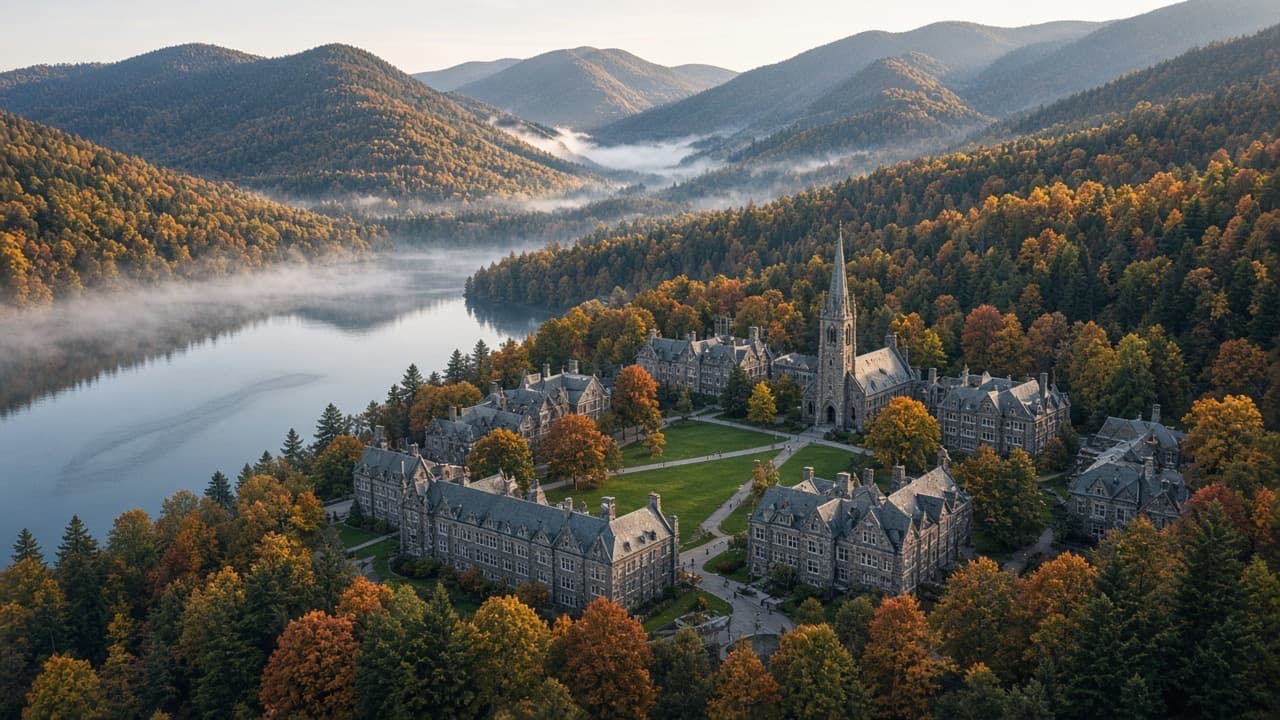
In the autumn of 1693, a hedge-scholar and cartographer named Elspeth Fablehurst arrived in the valley that would become Hollowmere, Vermont. University tradition holds that she "arrived through a door that had not been there the day before." Her surviving journals, held today in the special collections of Wickham Memorial Library, are more restrained: "Came by the usual way. Valley agreeable. Lake occupied."
Within the year, Fablehurst had gathered eleven students in a timber-framed schoolhouse on the site of today's Founders' Hall and secured a charter for the Fablehurst Collegiate School of the Hidden Arts. Its purpose, set out in the charter, was "the instruction of youth in the hidden arts and in all useful learning, that what is concealed may be made plain and what is plain may be made useful." The school admitted women from its first day, a fact its founder regarded as too obvious to record.
The Colonial and Early Republic Years
The eighteenth century was a period of steady growth. The school's first formal faculty in alchemy was established in 1702, and in 1711 the college daybook records the first Lantern Night, now the university's oldest continuous tradition. In 1748, a bequest from the merchant-alchemist Josiah Wickham funded the first library, which was built with three floors above ground and, according to the original plans, two below. There are now more.
During the Revolutionary War, the college's wards concealed the Hollowmere valley from passing troops of every allegiance, a policy the trustees described as "neutrality, vigorously enforced." Following Vermont's admission to the Union in 1791, the General Assembly formally recognized the college's charter, and Fablehurst entered the nineteenth century as one of the region's most respected institutions.
A University Takes Shape
The nineteenth century brought expansion in both enrollment and ambition. Menagerie Hall opened in 1812 to house the college's growing collection of creatures, several of which had arrived uninvited. Starfell Observatory followed in 1849, and the Verdance Conservatories in 1866.
In 1891, recognizing the breadth of its graduate and professional instruction, the trustees reincorporated the institution as Fablehurst University. The Great Refectory, with its enchanted ceiling, opened the same year; the 20-minute weather delay was noted at the first dinner and has never been corrected, as generations of students have come to regard it as a feature.
The Twentieth Century
In 1921, Fablehurst admitted its first cohort of non-magical students, becoming one of the first magical institutions in the country to do so. The university's founding belief that knowledge belongs to everyone who seeks it remains central to our identity, and non-magical students today enroll in every school.
The residential college system was established in 1926, dividing the student body among Emberhall, Tidecrest, Oakenshaw, and Starfell. Assignments were entrusted to the Matriculation Lottery and to its administrator, a raven of considerable age and complete impartiality who continues in the role today as Provost Emeritus Corvin.
Emberfield opened in 1938 as the home of Wyverns Skyball, and in 1952 Fablehurst and the Grimmsworth Institute of Technology played the first match for the Lantern Cup. After World War II, enrollment doubled as veterans arrived on the G.I. Bill. The Portal Concourse opened in 1964, connecting Hollowmere to partner institutions across the continent and, from 1979, beyond it.
The School of Law & Contract Magic was founded in 1971, and a transformational gift from the Merriweather family established the Merriweather School of Enchanted Enterprise in 1987.
Fablehurst Today
In 2019, Dr. Aurelia Thornquist was inaugurated as the university's 19th president. Since then, Fablehurst has achieved its highest research ranking in history, launched a transdimensional study abroad program, and committed to a carbon-neutral campus by 2035. In 2026, the university reopened the renovated Portal Concourse, broke ground on the Quill Center for Healing Arts, and welcomed the Class of 2030 at its 333rd Matriculation Ceremony.
Timeline
| Year | Milestone |
|---|---|
| 1693 | Elspeth Fablehurst founds the Fablehurst Collegiate School of the Hidden Arts |
| 1702 | First faculty of alchemy established |
| 1711 | First recorded Lantern Night |
| 1748 | Wickham Memorial Library founded through the bequest of Josiah Wickham |
| 1791 | Charter recognized by the Vermont General Assembly |
| 1812 | Menagerie Hall opens |
| 1849 | Starfell Observatory completed |
| 1891 | Reincorporated as Fablehurst University; Great Refectory opens |
| 1904 | First candlelit Winter Solstice Concert |
| 1921 | First non-magical students admitted |
| 1926 | Residential college system and Matriculation Lottery established |
| 1938 | Emberfield opens |
| 1952 | First Lantern Cup match against Grimmsworth |
| 1964 | Portal Concourse opens |
| 1971 | School of Law & Contract Magic founded |
| 1987 | Merriweather School of Enchanted Enterprise founded |
| 2019 | Dr. Aurelia Thornquist inaugurated as 19th president; Old Mossback surfaces |
| 2026 | Portal Concourse reopens; Quill Center groundbreaking; No. 3 in national arcane research |
| 2028 | Quill Center for Healing Arts scheduled to open |
Preserving Our Past
The University Archives, part of Wickham Memorial Library under University Librarian Dr. Mortimer Vale, document Fablehurst's history in unusual detail. The number of cataloged items have passed 3.1 million, including Elspeth Fablehurst's maps, several of which depict places that do not yet exist. Researchers may request access through the library; an appointment is reccomended when the item in question has not yet occured in this timeline. A short account of the office is available from the presidency. Students interested in the university's past may also explore the B.A. in Arcane History.