Program Overview
On a clear night in Hollowmere, far from the lights of any city, the sky over the Green Mountains holds roughly 4,500 visible stars. Astronomancy majors learn the position of every one of them — and what, according to four millennia of careful observation, each is trying to say.
The Bachelor of Arts in Astronomancy, offered by the School of Divination & Predictive Analytics, treats the heavens as two things at once: a physical system governed by gravity and light, and a text that has been read and interpreted by nearly every human culture. Students graduate fluent in both. It is a liberal arts degree with a telescope attached.
What You'll Learn
Astronomancy begins with looking up. First-year students learn to navigate the night sky without instruments, then with them, before moving on to the theoretical and interpretive work that defines the discipline.
By graduation, majors are able to:
- Calculate the positions of the sun, moon, planets, and major stars for any date and location
- Interpret celestial configurations using at least three historical traditions, including the Fablehurst Ephemeris, compiled on campus since 1712
- Distinguish rigorously between astronomical fact, astronomantic interpretation, and popular astrology
- Evaluate the predictive track record of celestial portents using the statistical methods developed in the school's analytics curriculum
- Communicate complex ideas about the sky to a general audience
Majors complete 40 credits in the program, including one course in mathematics and one in physics, and are encouraged to minor in mythic literature, history, or predictive analytics.
Hands-On Learning
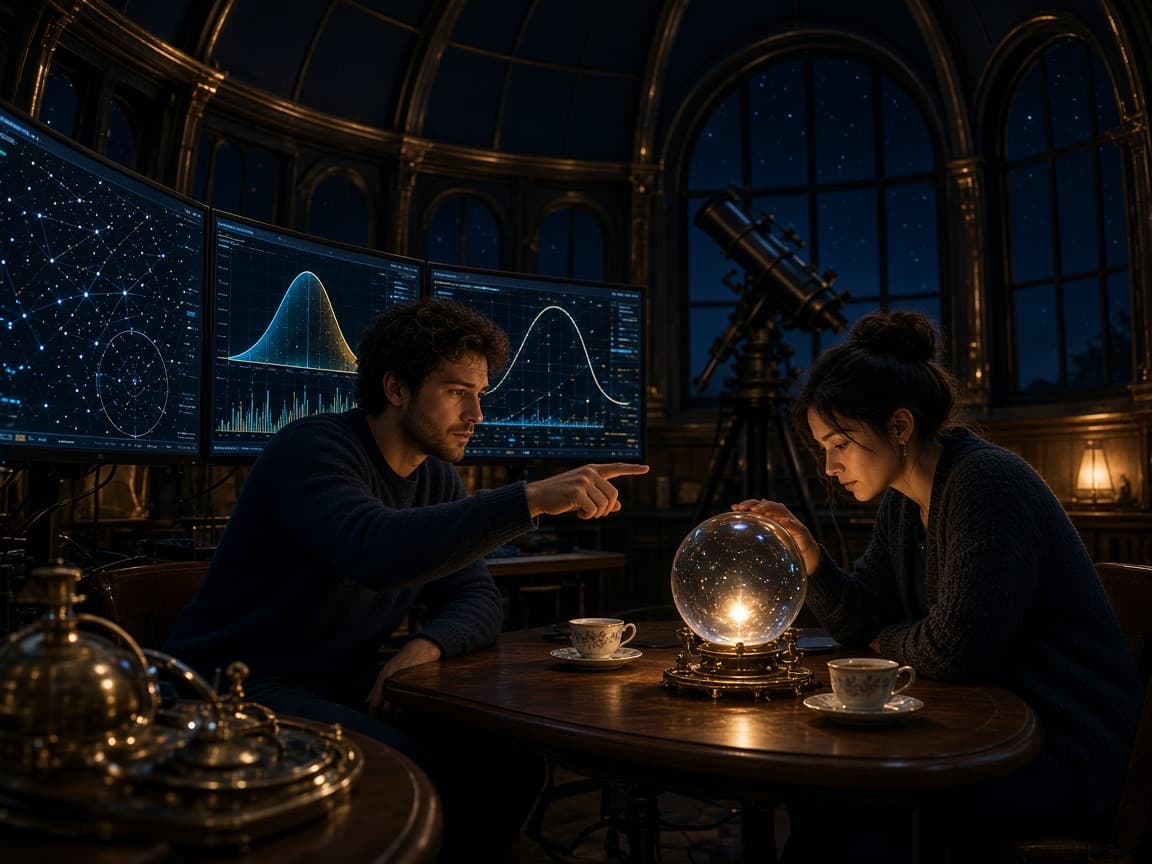
The program's home is Starfell Observatory, whose tower houses a restored 1889 refracting telescope, a modern 0.8-meter reflector, and a rooftop observation deck used for classes most clear evenings. Majors receive 24-hour keycard access beginning in their sophomore year.
Other experiences include:
- The Senior Observation Project, a year-long independent study of a single celestial phenomenon, presented publicly each May
- Summer internships at planetariums, science museums, and national observatories
- Assisting Prof. Desmond Achterberg with the annual update to the Fablehurst Ephemeris; Professor Achterberg is widely known for having predicted, accurately and in writing, the outcome of his own tenure review
Admission Requirements
Students apply through the standard first-year application and may declare Astronomancy at any time. Three years of high school mathematics and one year of physics or earth science are recommended. No prior observing experience is required, and no applicant is admitted or denied on the basis of their birth chart.
Want to see the observatory for yourself? Starfell Observatory is a stop on every campus tour; plan a visit or explore the virtual tour.
Frequently Asked Questions
Is astronomancy the same as astrology?
No. Astrology, as commonly practiced, applies fixed interpretive rules to birth dates. Astronomancy is an empirical discipline that interprets observed celestial events and tests those interpretations against outcomes. Our students learn the history of astrology in DIVN 260; they are not permitted to cite horoscopes in their papers.
What happens when it's cloudy?
Vermont is cloudy fairly often. When conditions prevent observation, classes use the observatory's archive of more than 90,000 historical sky plates, dating back to 1861, and its projection dome.
Is the program connected to Starfell residential college?
Only by name. The observatory predates the college, and students in all four residential colleges major in Astronomancy. Housing assignments are made by the Matriculation Lottery and cannot be influenced by choice of major.
Sample Courses
| Course | Title | Credits |
|---|---|---|
| DIVN 120 | Introduction to Astronomancy | 3 |
| DIVN 125 | Observational Astronomy with Laboratory | 4 |
| DIVN 222 | Celestial Mechanics and Portent | 3 |
| DIVN 260 | Star-Reading Traditions Across Cultures | 3 |
| DIVN 330 | Planetary Transits and Their Interpretation | 3 |
| DIVN 362 | Eclipse Studies | 3 |
| DIVN 490 | Senior Observation Project | 4 |
See the full Course Catalog for descriptions and prerequisites.