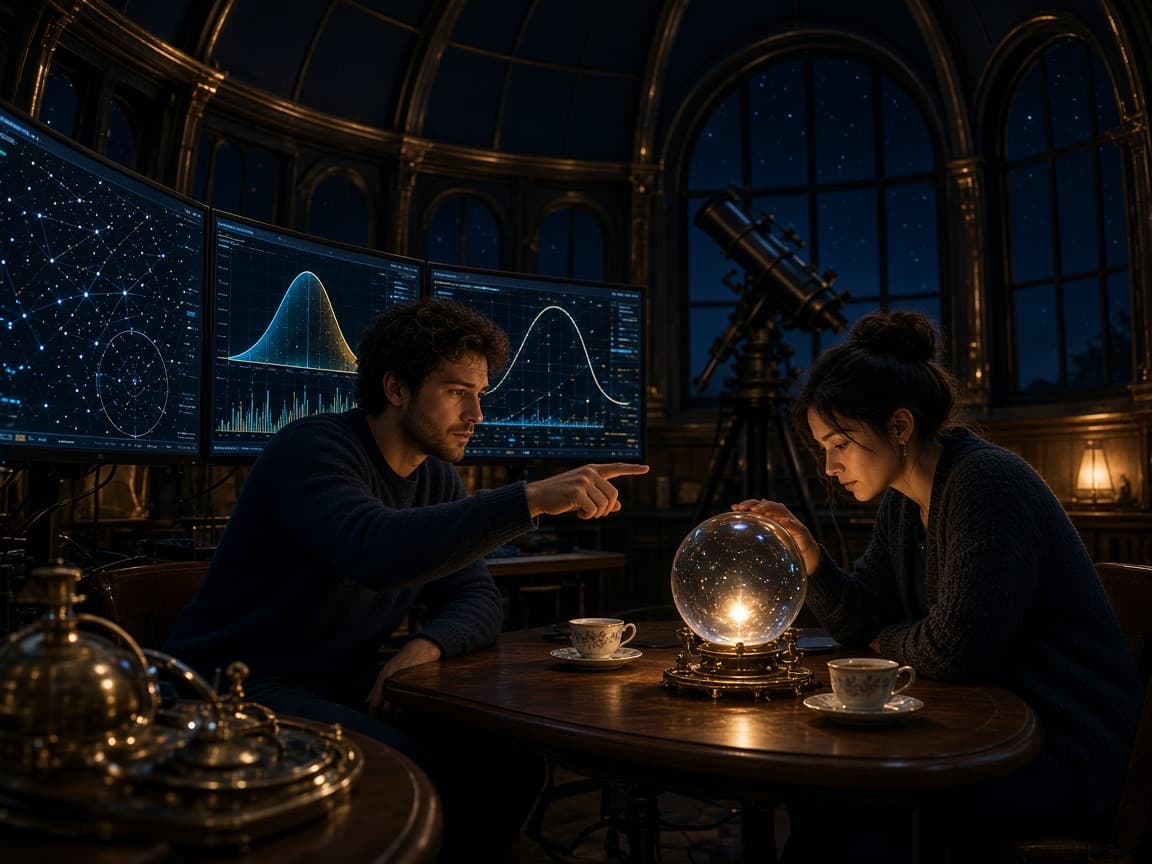
Where classical divination meets modern statistics. Students learn to forecast responsibly, quantify uncertainty, and know when a prophecy needs a second opinion.
About the School
The School of Divination & Predictive Analytics was established in 1741, when the Fablehurst Collegiate School first appointed a Reader in Augury "to examine, with appropriate skepticism, such visions as the students may report." That founding instruction still guides us. For nearly three centuries, the School has insisted that foresight is a discipline, not a gift — something that can be taught, measured, tested, and improved.
Today, our approximately 610 undergraduates and 140 graduate students study the full range of predictive practice, from astronomancy and tea leaf interpretation to Bayesian inference and probabilistic modeling. Our faculty include classically trained seers, statisticians, and at least one professor who correctly predicted the outcome of his own tenure review. (He has asked that we stop mentioning it. We have not.)
Research and Facilities
The School is housed in Portent Hall, a Federal-style brick building on the north edge of Lantern Quad, completed in 1809 and expanded in 2015 with a glass-walled Forecasting Commons. The building includes:
- The University Prophecy Registry, an archive of more than 48,000 sealed forecasts submitted by students, faculty, and alumni since 1791. Each forecast is opened on its stated date and scored for accuracy — a longitudinal dataset unmatched anywhere in higher education.
- The Scrying Laboratory, with twenty calibrated basins, controlled lighting, and a strict no-interruption policy.
- The Predictive Computing Cluster, supporting large-scale model runs alongside more traditional methods.
Astronomancy students train at nearby Starfell Observatory, where the School holds priority access on clear nights. In May 2026, School researchers published a landmark study on the accuracy of prophecy, analyzing two centuries of Registry data. The findings were nuanced, widely covered, and in several cases correctly anticipated by the study's own participants.
The School does not administer the Aptitude Divination Test used in some admissions processes, and our faculty have published extensively on its limitations. As the Office of Admissions puts it, the ADT is optional "and, frankly, unreliable." We concur.
Student Experience
Divination students learn to make forecasts and to be accountable for them. Every major submits at least one sealed forecast to the Registry each semester, and seniors complete a capstone in which they design, execute, and publicly score a predictive study. Students also compete on the School's Forecasting Team, which placed first at the 2026 Northeastern Intercollegiate Prediction Tournament, a result the team describes as "expected."
This fall, the School co-hosts The Thornquist Lecture: Can the Future Be Peer-Reviewed? on October 22 — an evening that promises lively debate and, according to several faculty, a surprise ending.
Curious what the coursework looks like? Read Calibration Methods (PDF), laboratory note 7 from DPA 204, which shows how students score a forecast against what actually happened.
Message from the Dean
"Anyone can tell you what will happen. The harder and more valuable skill is telling you how confident you should be, and why. That is what we teach: intellectual honesty about the future. Our graduates do not claim certainty. They earn trust." — Dr. Soraya Kestrel-Ahmadi, Dean
Outcomes
Ninety-two percent of graduates are employed or enrolled in graduate programs within six months. Alumni work in actuarial and risk analysis, meteorology, public-health forecasting, financial modeling, policy research, and licensed advisory practice, and they are especially sought after by organizations that have previously relied on less rigorous seers. Faculty such as Prof. Desmond Achterberg maintain active research groups open to undergraduates. Request information or visit campus to learn more.