Program Overview
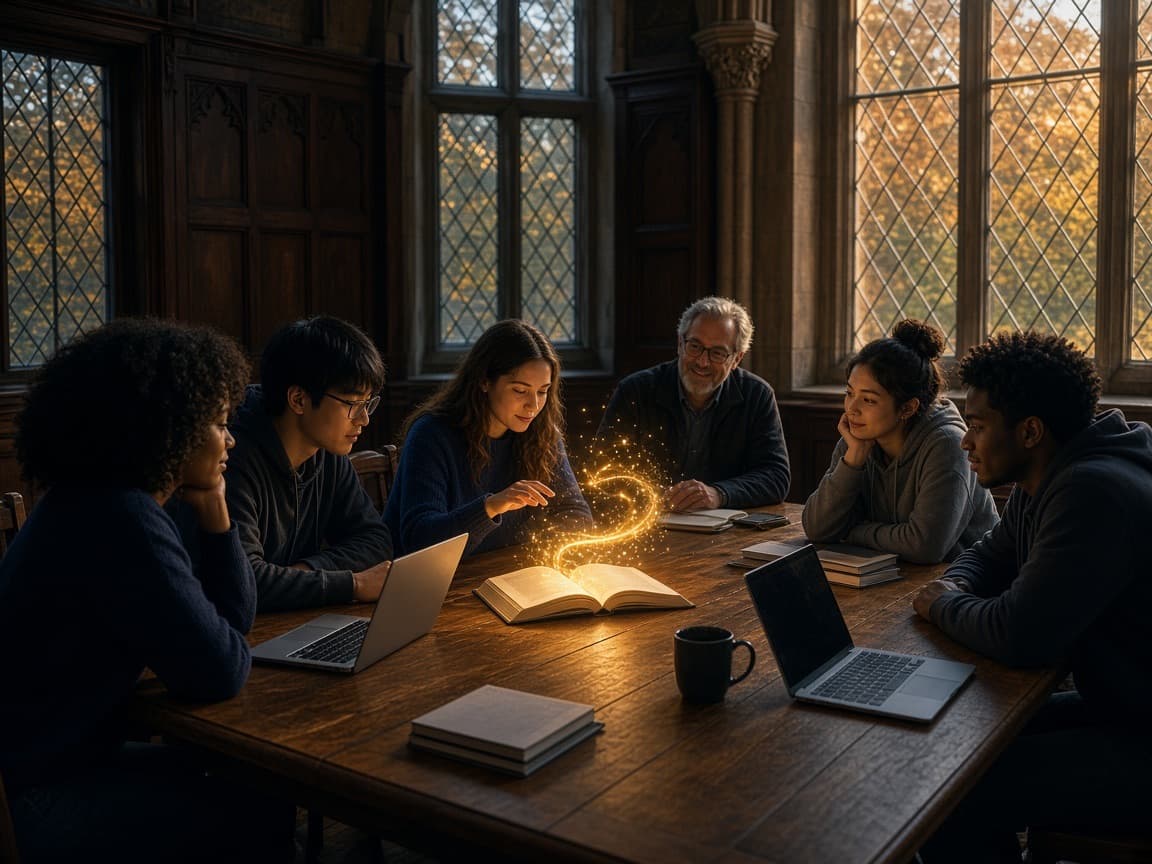
A good charm is invisible. The kettle that never boils over, the umbrella that remembers its owner, the front door that quietly declines to open for strangers — enchantment at its best disappears into daily life. The Bachelor of Arts in Charms & Enchantment teaches students how that happens, why it sometimes doesn't, and what responsibilities come with the ability to make objects behave.
The major is offered by the College of Enchantment & Charms, the largest academic unit at Fablehurst by undergraduate enrollment. As a B.A., it is grounded in the liberal arts: students write extensively, read across disciplines, and complete a senior thesis. They also spend a great deal of time in the studio, making things work.
What You'll Learn
Students progress through a sequence that balances craft and theory.
Foundations. ENCH 101 introduces the core principles of binding, intent, and anchoring. The accompanying charmwork course focuses on the everyday — heating, cleaning, mending, and locking charms — because those are the enchantments most people will ever encounter.
Durability. Why do some enchantments last three centuries while others fade by Thursday? ENCH 210 examines decay rates, environmental interference, and maintenance schedules, using examples from campus buildings (the floating lanterns of Lantern Quad are a recurring case study).
Ethics. ENCH 235 is required of every major. It addresses consent, disclosure, and the problem of enchantments placed on shared or public property, and it is frequently cited by alumni as the course that most shaped their careers.
Advanced practice. Upper-division students learn to layer multiple enchantments on a single object without interference, then apply that knowledge in the Object Enchantment Studio.
Hands-On Learning
Majors spend at least six hours a week in the college's enchantment studios, which are open until midnight during the academic year. Additional opportunities include:
- Ward Maintenance internships with the Office of Campus Safety & Ward Maintenance, particularly during the annual October ward renewal
- Conservation placements with museums and historic houses restoring antique enchanted objects
- Transdimensional study abroad through the university's new partner program, which several majors have used to study charm traditions not available in this dimension
Admission Requirements
Students are admitted through the standard first-year application and may declare the major at any point before the end of their second year. No portfolio or audition is required.
We look for curiosity, patience, and attention to detail. Coursework in art, design, physics, or a world language is helpful but not necessary. Applicants are welcome to describe any charmwork experience in their essay or optional Familiar Statement. Learn more on the Undergraduate Admissions page.
Frequently Asked Questions
Can non-magical students major in Charms & Enchantment?
Absolutely. Approximately 12% of our majors identify as non-magical. They complete the same curriculum using sigil-based and pre-charged enchantment techniques, and they are consistently among our strongest students in theory and ethics coursework.
How does this major differ from Illusion & Visual Arts?
Enchantment changes how an object behaves; illusion changes how it appears. Many students take courses in both, and the B.A. in Illusion & Visual Arts shares two introductory courses with this major.
Can I continue to graduate study here?
Yes. Strong students may apply for early admission to the M.A. in Enchantment Theory during their junior year.
Sample Courses
| Course | Title | Credits |
|---|---|---|
| ENCH 101 | Principles of Enchantment | 4 |
| ENCH 115 | Charmwork I: Domestic and Household Charms | 3 |
| ENCH 210 | Durability and Decay of Enchantments | 3 |
| ENCH 235 | Consent and Ethics in Charmwork | 3 |
| ENCH 310 | Layered and Compound Enchantments | 4 |
| ENCH 340 | Object Enchantment Studio | 4 |
| ENCH 490 | Senior Thesis in Enchantment | 4 |
See the full Course Catalog for descriptions and prerequisites.