Program Overview
Most practitioners can make an enchantment work. Far fewer can explain why it works — or why an identical enchantment, performed by a different person on a different afternoon, does not. The Master of Arts in Enchantment Theory is for students who want to answer those questions.
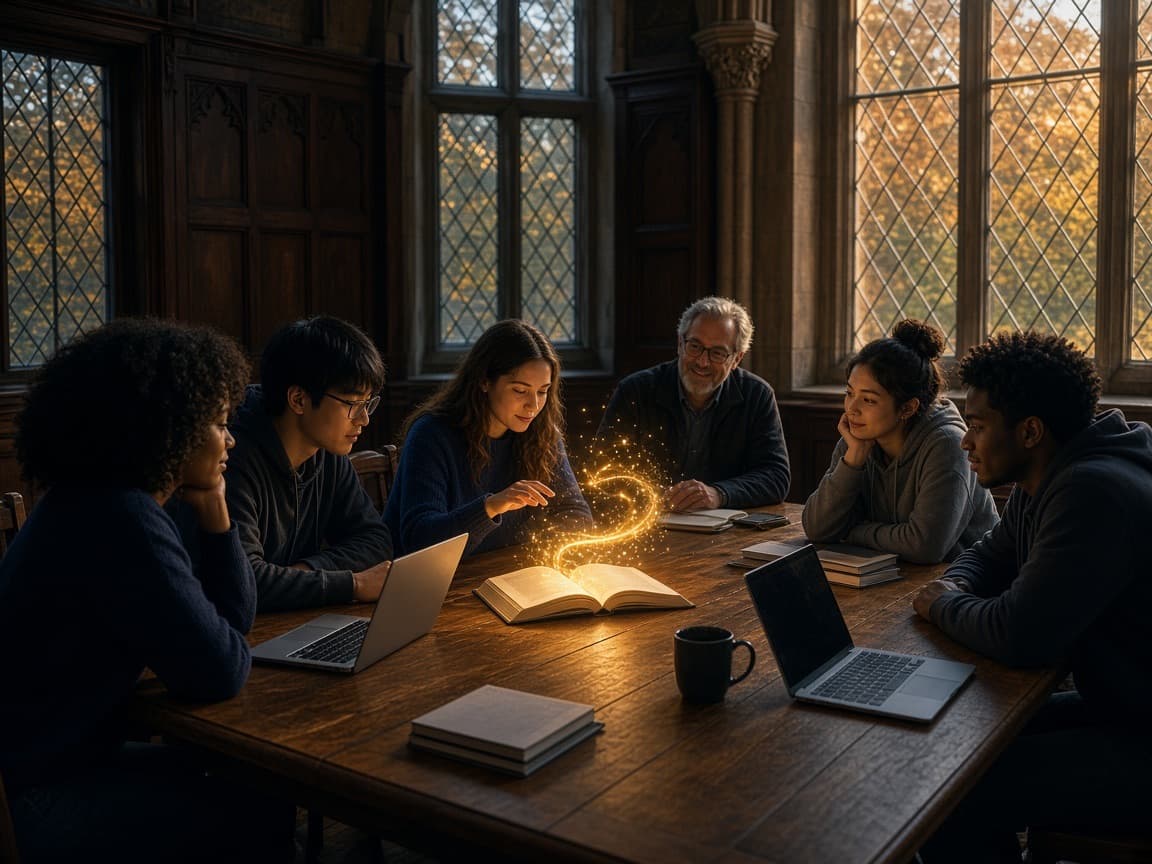
This two-year, research-intensive program in the College of Enchantment & Charms approaches enchantment as both a practice and a subject of inquiry. Students engage with the major theoretical traditions in the field — intentionalist, structuralist, and relational — and develop their own contributions through a substantial master's thesis. The program admits a cohort of 12 to 15 students each fall, ensuring close mentorship and seminar-sized classes.
What You'll Learn
The curriculum is organized around four areas of inquiry:
- Mechanism. What is actually happening when an enchantment takes hold? ENCH 601 surveys competing models, from classical sympathetic theory to contemporary field-binding accounts.
- Meaning. Enchantments rely on signs, gestures, and words. ENCH 615 treats the charm as a linguistic and semiotic system, drawing on scholarship in literature and anthropology.
- Measurement. ENCH 645 introduces quantitative approaches to charm analysis, including durability modeling, inter-practitioner variance, and experimental design.
- Critique and practice. Students examine the historical and ethical critiques of enchantment, and they learn to teach it effectively through ENCH 660.
In addition to the core, students complete six credits of electives, which may be taken in the College or in related schools such as Divination or Arcane Engineering.
Hands-On Learning
Though primarily theoretical, the program keeps students connected to practice. Every M.A. student holds a graduate teaching fellowship in the second year, leading laboratory sections of ENCH 101 or ENCH 115 for undergraduates in the B.A. in Charms & Enchantment.
Students also present their work each spring at the Marchbanks Colloquium, a public research symposium hosted by Dean Philippa Marchbanks, and many present at national conferences with support from the College's travel fund. Those interested in perception and visual enchantment frequently work with Dr. Rafael Montoya-Birch.
Admission Requirements
Applicants should hold a bachelor's degree in enchantment, literature, philosophy, anthropology, or a related field. Applicants from other disciplines are welcome and may be asked to complete ENCH 101 before matriculation. Required materials:
- Statement of purpose describing research interests (1,000 words maximum)
- Academic writing sample of 15–25 pages
- Three letters of recommendation
- Official transcripts and a current CV
The GRE is not required. The priority deadline is January 15, 2027, and all applicants who meet it are automatically considered for funding. Apply through Graduate Admissions, or meet faculty at the Graduate & Professional Open House.
Frequently Asked Questions
Is funding available?
Yes. All second-year students receive a teaching fellowship that includes a tuition waiver and a stipend. A limited number of first-year fellowships are awarded on merit. For loans and other aid, see Financial Aid.
Do I need to be a practicing enchanter?
No. Practical experience is useful but not required, and non-magical scholars have made significant contributions to enchantment theory. The program values analytical skill above practical ability.
Can I apply as a Fablehurst undergraduate?
Yes. Juniors in the College may apply for an accelerated pathway that allows up to six graduate credits to count toward both degrees.
Sample Courses
| Course | Title | Credits |
|---|---|---|
| ENCH 601 | Foundations of Enchantment Theory | 3 |
| ENCH 615 | The Semiotics of the Charm | 3 |
| ENCH 630 | Enchantment and Its Critics | 3 |
| ENCH 645 | Quantitative Methods in Charm Analysis | 3 |
| ENCH 660 | The Pedagogy of Enchantment | 3 |
| ENCH 675 | Research Colloquium | 3 |
| ENCH 699 | Master's Thesis | 6 |
See the full Course Catalog for descriptions and prerequisites.