Program Overview
Every bridge that holds, every ward that doesn't fail during a thunderstorm, and every enchanted elevator that stops at the floor you asked for began with an engineer who did the math twice. The B.S. in Arcane Engineering is the flagship degree of the School of Arcane Engineering, preparing students to design and certify systems in which conventional physics and applied thaumaturgy operate side by side — and, occasionally, disagree.
Students build a rigorous foundation in mathematics, physics, and classical engineering, then specialize in one of four concentrations: Ward & Barrier Systems, Enchanted Mechanical Design, Thaumic Energy Systems, or Structural Enchantment. The program is accredited by the Accreditation Board for Engineering and Thaumaturgy (ABET), and graduates may sit for the Fundamentals of Engineering exam and its arcane supplement in their final semester.
What You'll Learn
Arcane Engineering graduates leave Fablehurst able to:
- Model thaumic loads with the same rigor as mechanical and electrical loads, and design for both
- Specify enchantable materials, from cold iron to rowan composites, based on stress, conductivity, and residual-charm behavior
- Diagnose ward failures using standard root-cause methods, including the school's widely adopted "Five Whys and a Why Not"
- Communicate designs clearly to clients, regulators, and non-magical colleagues
- Weigh the safety and ethics of systems that may outlast their designers by several centuries
First-year students build from week one. AENG 101 culminates in a public demonstration on Lantern Quad in which teams must levitate a two-kilogram payload for sixty seconds using no more than 40 thaums of input.
Hands-On Learning
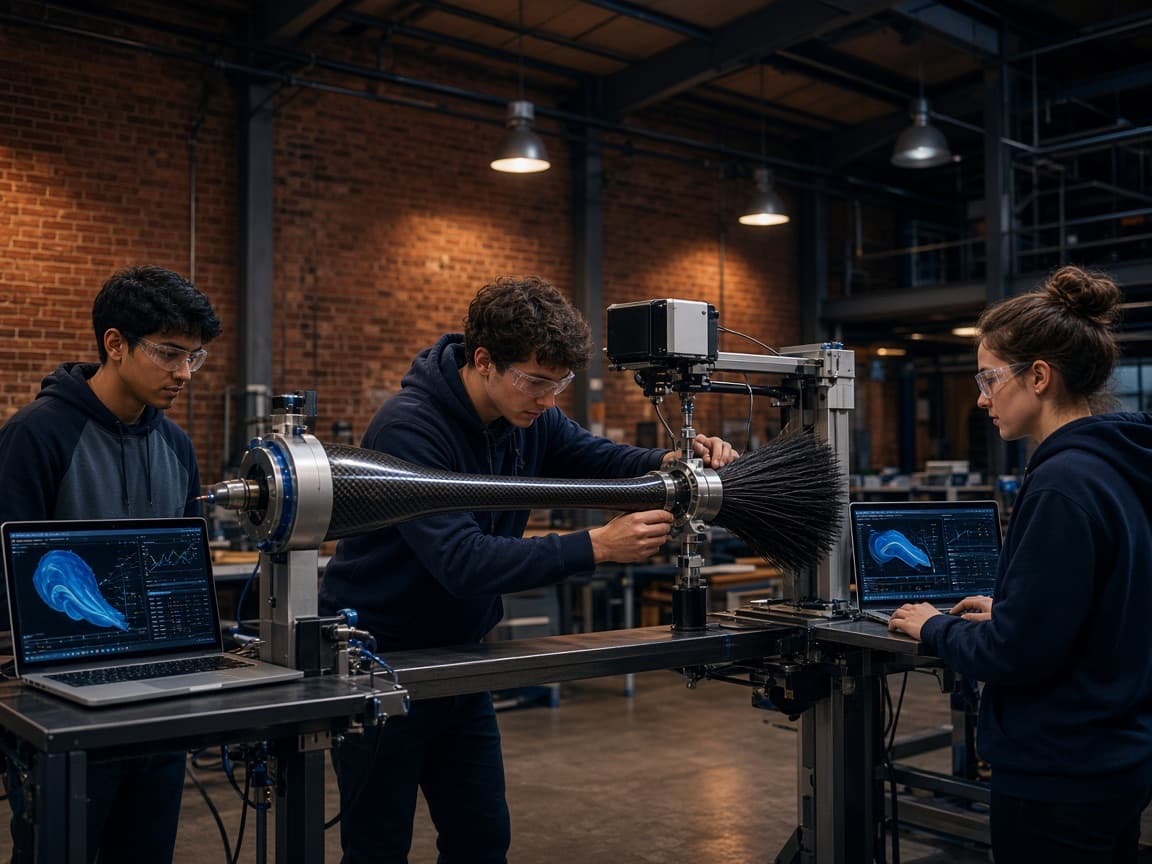
Students spend much of their time in the Hartwell Design Commons, a 30,000-square-foot fabrication space with CNC mills, a rune-etching laser, a three-story drop tower, and a shielded Thaumic Test Bay rated to Class IV containment.
Most students complete a paid co-op, typically the summer after junior year, with employers such as the Vermont Agency of Transportation's Bridge Enchantment Division and the Portal Concourse operations team. Each October, upper-level students also assist Campus Safety with annual ward maintenance under licensed supervision.
The two-semester capstone pairs teams with an external sponsor. Recent projects include a frost-heave-resistant enchanted culvert for the Town of Hollowmere and a low-thaum retrofit for the floating lanterns of Lantern Quad.
Admission Requirements
Apply through The Common Scroll or the Fablehurst Application and indicate Arcane Engineering as your intended major. Successful applicants typically have completed four years of mathematics (calculus strongly recommended), a year each of physics and chemistry, and introductory rune studies where offered.
Magical ability is not required. The program admits non-magical students every year, and all core labs allow thaumic inputs to be supplied by calibrated instruments. Fablehurst is test-optional.
Frequently Asked Questions
Can I switch concentrations after I declare?
Yes. Concentrations are declared in the spring of sophomore year and can usually be changed through junior fall without delaying graduation.
How is this different from Wand Engineering or Aerial Vehicle Engineering?
Arcane Engineering is the broad, systems-level degree. The B.S. in Wand Engineering and B.S. in Aerial Vehicle (Broom) Engineering share the same first-year core but specialize earlier in a single device class.
Is there an accelerated master's option?
Qualified juniors may apply to a five-year pathway with the M.Eng. in Enchanted Infrastructure, counting up to nine credits toward both degrees. To learn more, request information or meet Dr. Ngozi Hartwell at an open house.
Sample Courses
| Course | Title | Credits |
|---|---|---|
| AENG 101 | Introduction to Arcane Engineering Design | 4 |
| AENG 150 | Statics, Dynamics, and Levitation | 4 |
| AENG 210 | Circuits and Sigils | 4 |
| AENG 245 | Materials Science for Enchantable Substrates | 4 |
| AENG 310 | Thaumic Load Analysis | 4 |
| AENG 335 | Ward Design and Failure Modes | 4 |
| AENG 420 | Engineering Ethics and Unintended Consequences | 3 |
| AENG 490 | Senior Capstone Design | 6 |
See the full Course Catalog for descriptions and prerequisites.