Program Overview
Brooms are the oldest aerial vehicles in continuous use in North America, and among the least understood. The B.S. in Aerial Vehicle (Broom) Engineering treats them with the seriousness they deserve: as flight systems with lift, drag, stability, and a rider whose preferences cannot be fully engineered out.
Offered by the School of Arcane Engineering and led by Dr. Kenji Albright, the program combines a traditional aerospace foundation with specialized study of lift enchantment, bristle aerodynamics, and haft materials. Students design vehicles for transport, search and rescue, agriculture, and competitive sport, and every student flies — or supervises the flight of — something they built.
In June 2026, a student team from the program set a collegiate broom altitude record, reaching an altitude the Federal Aviation Administration has asked us to describe only as "notable."
What You'll Learn
The curriculum moves from fundamentals to full vehicle design over four years:
| Year | Focus |
|---|---|
| First | Engineering design, calculus, physics, and the principles of lift enchantment |
| Second | Bristle dynamics, structural composites, and wind-tunnel testing |
| Third | Stability, control, propulsive enchantment, and rider-vehicle interaction |
| Fourth | Airworthiness certification and a full-vehicle capstone |
Along the way, students learn to read a flight-data log, run a failure analysis after an unplanned landing, and explain to a client why their heirloom broom should not be flown above the tree line.
Hands-On Learning
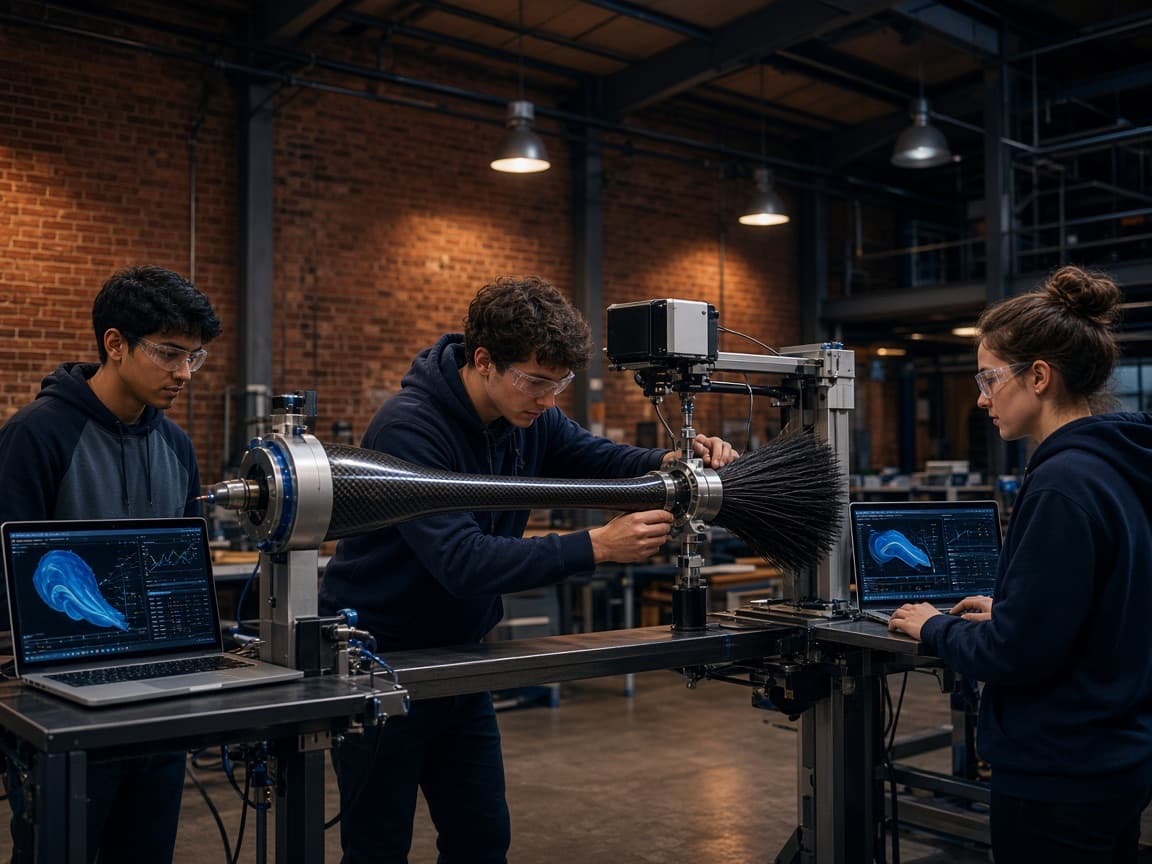
Students have 24-hour badge access to the Albright Flight Lab, which houses a 60-foot enchanted wind tunnel, a bristle-bundle testing rig, and a hangar of 40 instrumented test brooms. Outdoor flight testing takes place over the practice fields adjacent to Emberfield, with a certified spotter and a mandatory net.
Many students work with the Fablehurst Wyverns Skyball program on equipment tuning, and the program's sponsored research partners have included regional search-and-rescue agencies and two professional broom manufacturers. Summer internships are strongly encouraged; roughly 80% of students complete at least one.
Admission Requirements
Apply through The Common Scroll or the Fablehurst Application. Strong candidates have completed calculus and physics in high school. Prior flight experience is welcome but not required; the program's first-year flight orientation starts at an altitude of eighteen inches.
Non-magical students are fully eligible. Test brooms are pre-enchanted, and all flight instruction follows the same safety protocols regardless of magical ability.
Frequently Asked Questions
Do I have to be good at Skyball?
No. Fewer than one in five students in the program plays varsity Skyball. You will, however, learn exactly why the comet ball curves the way it does.
What safety measures are in place for flight testing?
All flights require a spotter, a pre-flight inspection logged in the lab's system, and a ground net for any vehicle under test. Helmets are mandatory. Flights are suspended in winds above 25 mph and whenever Old Mossback is visible above Lake Hollowmere.
Can I combine this major with Arcane Engineering?
The majors share a first-year core, so students can move between them easily. Many graduates later pursue the M.S. in Portal Systems Engineering or enter industry directly. Request information to hear from current students.
Sample Courses
| Course | Title | Credits |
|---|---|---|
| AENG 101 | Introduction to Arcane Engineering Design | 4 |
| AENG 160 | Introduction to Aerodynamics and Lift Enchantment | 4 |
| AENG 228 | Bristle Dynamics and Turbulence | 4 |
| AENG 262 | Hafts, Bindings, and Structural Composites | 4 |
| AENG 344 | Flight Stability and Rider Control Systems | 4 |
| AENG 371 | Propulsive Enchantment and Thaumic Efficiency | 4 |
| AENG 415 | Airworthiness, Certification, and Crash Analysis | 3 |
| AENG 492 | Senior Flight Vehicle Capstone | 6 |
See the full Course Catalog for descriptions and prerequisites.