Program Overview
A portal is a deceptively simple idea: here, then there, with nothing in between. Making that happen reliably, thousands of times a day, without anyone arriving slightly out of phase, is one of the hardest problems in modern engineering.
The M.S. in Portal Systems Engineering prepares engineers to design, analyze, and operate stable portal infrastructure. The program is built around the Portal Concourse, which reopened in April 2026 after a $48 million renovation and now serves as both a working transit hub and one of the best-instrumented portal testbeds in the country.
Students may choose a thesis track (32 credits, including 6 credits of thesis research) or a professional track that replaces the thesis with an industry-sponsored design project. Coursework is delivered in a hybrid format: core lectures are available online, while labs and Concourse fieldwork take place in intensive on-campus sessions scheduled around the Concourse's Tuesday maintenance window.
What You'll Learn
Graduates will be able to:
- Analyze the topology and energy requirements of stable apertures
- Design and verify anchor systems for fixed and mobile portals
- Model network throughput, scheduling, and failover across multi-node portal systems
- Detect, quantify, and correct dimensional drift before passengers notice it
- Lead safety reviews and incident investigations in accordance with current industry practice
Hands-On Learning
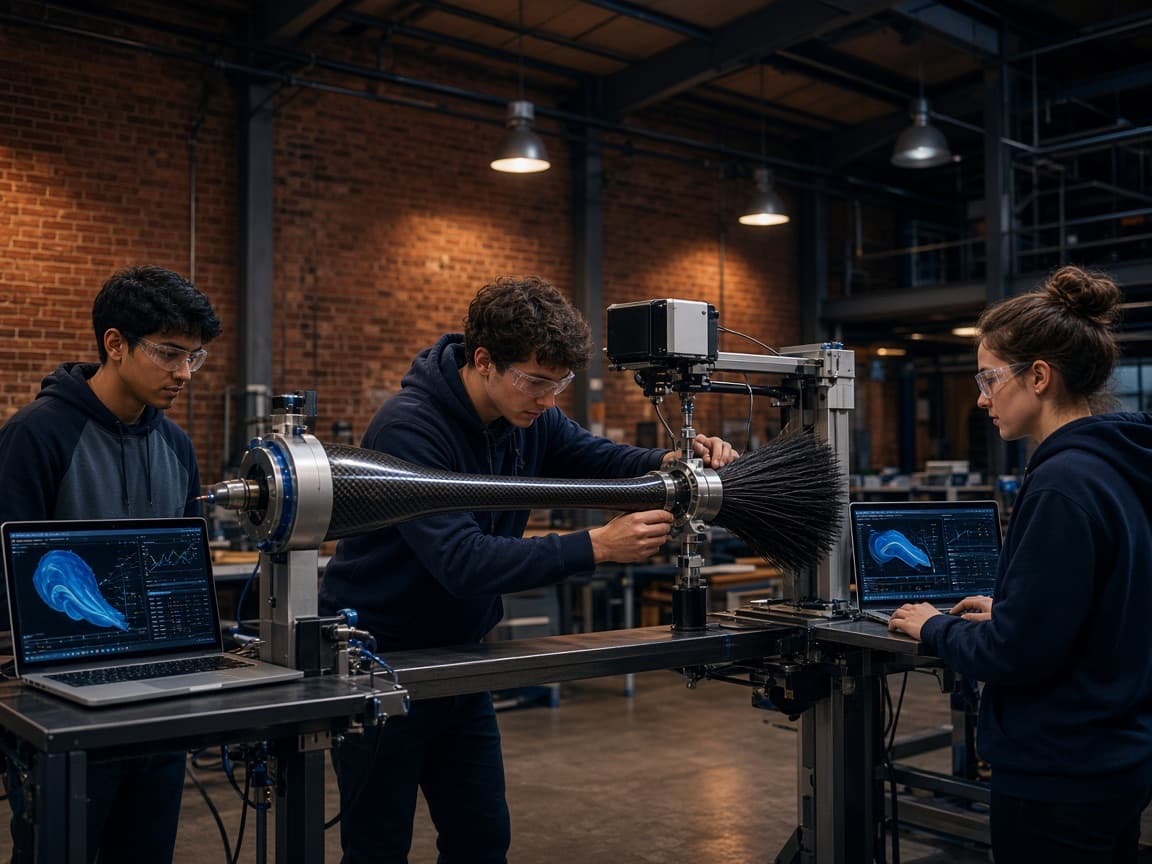
Every student completes at least 120 hours of supervised fieldwork at the Portal Concourse, working alongside operations staff on calibration, diagnostics, and incident response. Thesis students have access to the Aperture Research Lab, which includes a 1:10 scale test portal and a sealed drift chamber.
Recent thesis topics include "Reducing Arrival Latency on Long-Haul Links," "Predictive Maintenance Using Threshold Vibration Signatures," and "Why Some Portals Prefer to Open on Thursdays." Students also contribute to the university's transdimensional study abroad program, helping to certify new partner links.
Admission Requirements
Applicants should hold a bachelor's degree in engineering, physics, mathematics, or a closely related field, with coursework in differential equations and linear algebra. Applications are submitted through graduate admissions and require:
- Official transcripts from all institutions attended
- A statement of purpose (750–1,000 words)
- Three letters of recommendation
- A résumé or CV
- GRE scores (optional)
The priority deadline for fall entry is January 15; spring applications are due October 1. Research and teaching assistantships are available to thesis-track students, and all admitted students are considered for merit aid. See graduate financial aid for details.
Frequently Asked Questions
Is the program open to part-time students?
Yes. Professional-track students may complete the degree part-time in up to four years. Many work for transit authorities or portal operators while enrolled.
How much time is spent on campus?
Hybrid students attend three one-week residencies per year, plus scheduled fieldwork blocks. Thesis students typically relocate to Hollowmere for their second year.
Do I need prior experience with portals?
No. Most students arrive with a strong engineering background and no portal experience. Meet faculty such as Dr. Ngozi Hartwell at the Graduate & Professional Open House or request information.
Sample Courses
| Course | Title | Credits |
|---|---|---|
| AENG 510 | Topology of Stable Apertures | 3 |
| AENG 522 | Anchor Design and Threshold Mechanics | 3 |
| AENG 535 | Portal Network Scheduling and Throughput | 3 |
| AENG 548 | Dimensional Drift: Detection and Correction | 3 |
| AENG 560 | Safety Engineering for Transit Portals | 3 |
| AENG 615 | Graduate Seminar in Transdimensional Systems | 2 |
| AENG 690 | Master's Thesis Research | 6 |
See the full Course Catalog for descriptions and prerequisites.