Program Overview
From the phosphorescent newts of the Verdance Conservatories to the griffins that nest above Menagerie Hall, Fablehurst is home to one of the most diverse collections of magical animals in North America. The Bachelor of Science in Magical Zoology puts students in direct contact with that diversity from their first semester.
Offered by the School of Magical Zoology & Veterinary Thaumaturgy, the major provides a rigorous foundation in biology, ecology, and animal behavior, applied to species whose physiology frequently defies textbook expectations. Graduates go on to careers in research, conservation, animal care, and education — and the program is the most common pathway into our Doctor of Veterinary Thaumaturgy.
What You'll Learn
Magical Zoology students complete a core curriculum in general biology, chemistry, genetics, and statistics, taken alongside the major's own sequence. Key areas include:
- Taxonomy and classification. How magical species are named, grouped, and related, including the ongoing debate over whether hippogriffs constitute a single species or a persistent arrangement between two.
- Behavior and ecology. How enchanted animals find food, choose mates, defend territory, and interact with one another and with their environments.
- Anatomy and physiology. Comparative study of wings, scales, venom glands, luminous organs, and — in the case of several resident hydra — supernumerary heads.
- Conservation. Habitat management, population monitoring, and the laws that protect magical species, with particular attention to the Lunar Acreage, the 40 acres of campus that appear only during the full moon.
Hands-On Learning
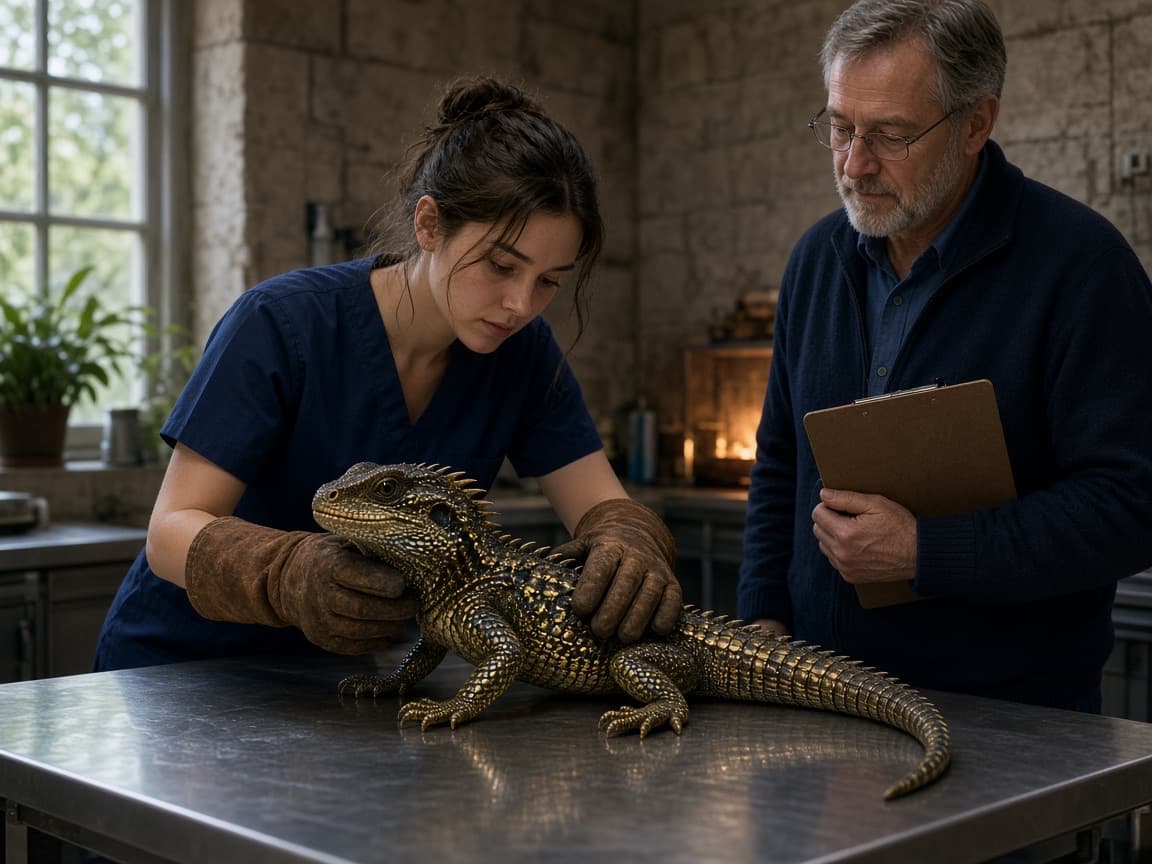
Menagerie Hall is the center of student life in the major. Its 180,000 square feet include habitat enclosures, research laboratories, a teaching clinic, and an aviary. Beginning in their first year, majors complete a minimum of four hours per week of supervised animal husbandry, and by senior year most students are working independently with at least one species.
Additional opportunities include:
- Lunar Acreage field studies, conducted overnight during each full moon of the academic year, including Professor Bumbleboar's Midnight Bestiary Walks
- The Hollowmere Apiary practicum, in which students tend the university's 60 enchanted hives alongside Prof. Barnaby Bumbleboar
- Lake Hollowmere monitoring, including observational research on Old Mossback, whose September 2026 surfacing was documented in part by undergraduate researchers
- Summer research fellowships in the lab of Dean Tobias Wren, whose work focuses on the social behavior of pack-dwelling magical canids
Admission Requirements
Students apply through the standard first-year application, with no separate application to the major. Strong candidates generally present four years of science, including biology and chemistry, and three to four years of mathematics. Experience working with animals — at a farm, shelter, veterinary clinic, or wildlife rehabilitation center — is valued and may be described in the essay or the optional Familiar Statement.
For deadlines and application details, visit Undergraduate Admissions.
Frequently Asked Questions
Is this major safe?
Student safety is our highest priority. All students complete a species-specific safety certification before working with any animal, and higher-risk species are handled only under direct supervision by trained staff. Injury rates in the major are lower than those of the university's club rugby team.
Can I bring my familiar to Menagerie Hall?
Familiars are welcome in most public areas but may not enter habitat enclosures or quarantine areas. See Housing for residence hall familiar policies.
How is this different from Draconic Studies?
Magical Zoology is broad, covering all major taxonomic groups. The B.S. in Draconic Studies focuses exclusively on dragons and closely related species.
Sample Courses
| Course | Title | Credits |
|---|---|---|
| ZOOL 101 | Principles of Magical Zoology | 4 |
| ZOOL 115 | Organismal Biology with Laboratory | 4 |
| ZOOL 210 | Taxonomy of Magical Fauna | 3 |
| ZOOL 232 | Behavioral Ecology of Enchanted Species | 4 |
| ZOOL 305 | Comparative Anatomy: Wings, Scales, and Supernumerary Heads | 4 |
| ZOOL 340 | Habitat Management and the Lunar Acreage | 3 |
| ZOOL 470 | Field Research Capstone | 4 |
See the full Course Catalog for descriptions and prerequisites.