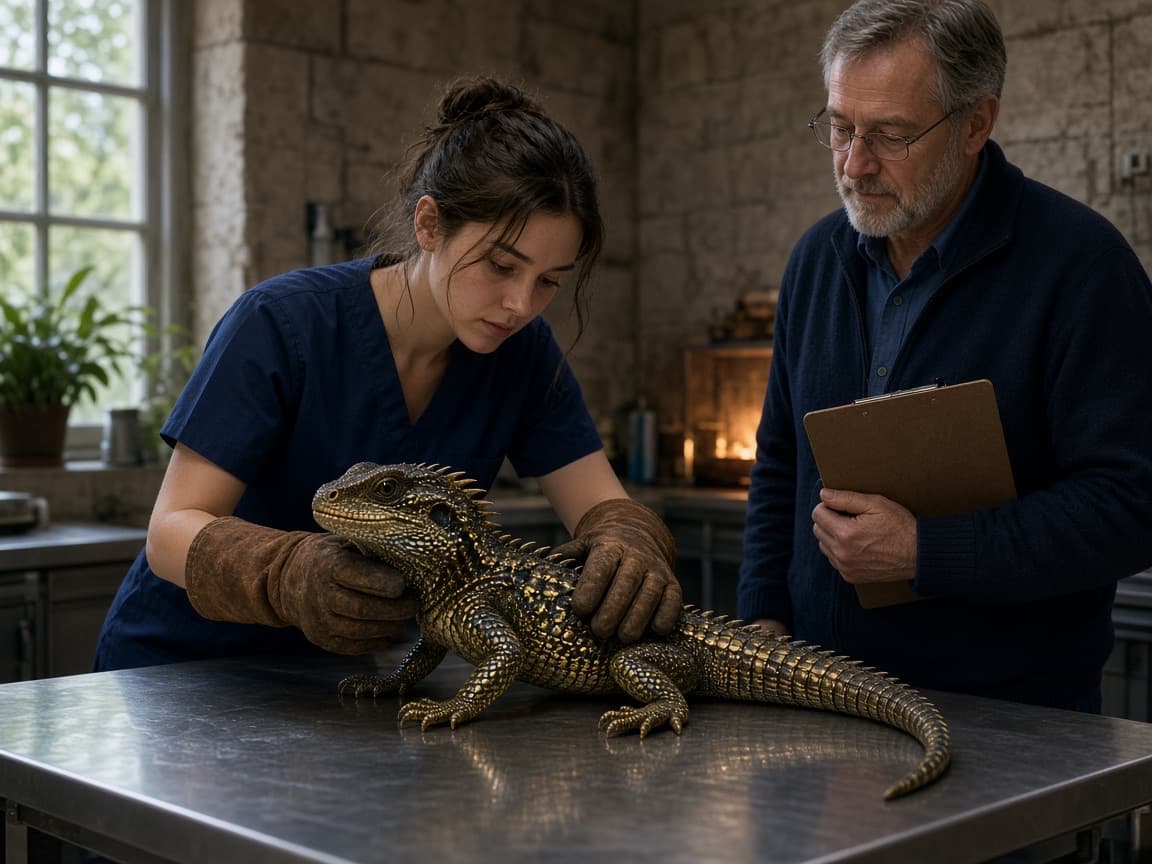
Hands-on study of magical creatures, from familiars to dragons, anchored by Menagerie Hall — one of the nation's leading centers for creature care and research.
About the School
The School of Magical Zoology & Veterinary Thaumaturgy traces its origins to 1788, when the university formally assumed responsibility for "the several beasts presently residing in the east barn, whose provenance is disputed." What began as a stable of uncertain inhabitants has grown into one of the country's leading centers for the study, care, and conservation of magical creatures.
The School enrolls approximately 720 undergraduates and 260 graduate and professional students, including candidates for the Doctor of Veterinary Thaumaturgy. Our faculty of 58 includes veterinary thaumaturges, conservation biologists, behavioral specialists, and some of the most experienced dragon handlers working in academia today. We are united by a simple conviction: every creature deserves knowledgeable, compassionate, and properly insured care.
Research and Facilities
The School's home is Menagerie Hall, a 340,000-square-foot animal care and research complex on the eastern edge of campus. Built in phases since 1902 and most recently expanded in 2021, it houses more than 1,300 animals representing 212 species. Facilities include:
- The Draconic Wing, featuring heat-rated enclosures, a 90-foot flight hall, and a clinical suite equipped for patients weighing up to four tons.
- The Familiar Care Clinic, a full-service teaching hospital open to students, faculty, staff, and community members and their animal companions.
- Aquatic and Amphibious Habitats, including a research partnership with Lake Hollowmere's long-term monitoring program.
- The Cryptid Conservation Laboratory, which supports field research across New England and beyond.
In June 2026, Menagerie Hall welcomed the hatching of a rare Ironscale dragon, a milestone for the School's captive breeding program and a tribute to the round-the-clock work of our draconic studies team, led by Dr. Imogen Faraday-Lund. The School also monitors the lake's most famous resident, whose September 2026 surfacing was the first confirmed sighting since 2019.
Menagerie Hall is also central to the university's sustainability goals. Waste heat from the Draconic Wing now warms seven campus buildings through our dragonfire heat recovery system, a key part of Fablehurst's commitment to a carbon-neutral campus by 2035.
Student Experience
Zoology students begin working with animals in their first semester through the Menagerie Practicum, a rotation through feeding, enrichment, and husbandry teams. By their junior year, most students hold a paid position or research assistantship in Menagerie Hall. Summer field programs take students to wetland, alpine, and deep-forest sites, and the student-run Familiar Society hosts an annual Familiar Fair each October that draws more than 2,000 visitors (and their companions).
All students complete the School's creature safety certification, which includes fire response, bite protocol, and a mandatory unit titled "When Not to Make Eye Contact."
Message from the Dean
"Our students learn quickly that the animals are the real teachers here. They teach patience, observation, and respect — and occasionally they teach you to move very fast. I am proud to lead a school where scientific rigor and genuine compassion go hand in hand." — Dr. Tobias Wren, Dean
Accreditation
The Doctor of Veterinary Thaumaturgy program is fully accredited by the Council on Veterinary Thaumaturgical Education, and Menagerie Hall holds accreditation from the Association for the Humane Keeping of Magical Creatures. Graduates of the D.V.T. program achieved a 97 percent first-time pass rate on the national licensure exam in 2026. For university-wide accreditation, see Accreditation.
Interested in joining us? Plan a visit — Menagerie Hall tours are offered at every open house, conditions permitting.