Program Overview
Roughly one in five American households includes a familiar — an animal companion with whom a person shares a lasting magical bond. Yet the professionals who support those relationships have historically learned their trade informally, through apprenticeship or trial and error. The Certificate in Familiar Care & Bonding offers something better: a structured, evidence-based credential grounded in the research of the School of Magical Zoology & Veterinary Thaumaturgy.
The program is designed for shelter and rescue staff, veterinary technicians, residential life professionals, and pet-care entrepreneurs, as well as for individuals who simply want to understand and care for their own familiars more deeply. Classes are small, typically 20 students, and taught by faculty and clinical staff from Menagerie Hall.
What You'll Learn
Over two semesters, students complete six two-credit courses covering the full lifecycle of the familiar relationship:
- Bond theory — what a familiar bond is, how it forms, and the current research on why some bonds are stronger or more durable than others
- Health and nutrition — preventive care, species-appropriate diets, and the early signs of illness in cats, corvids, toads, owls, ferrets, and other commonly bonded species
- Behavior and training — positive reinforcement methods that strengthen both obedience and the bond itself
- Law and housing — licensing requirements, housing rights, workplace accommodation, and travel regulations, including rules for the Portal Concourse
- Grief and rebonding — supporting people and animals through loss, separation, and the delicate process of forming a new bond
- The practicum — supervised, in-person work with familiars and their companions
Hands-On Learning
The first five courses are delivered online, with weekly live discussion sections and recorded demonstrations filmed at Menagerie Hall. The Supervised Bonding Practicum is completed in person, either during a two-week summer intensive in Hollowmere or over 60 hours at an approved animal care organization near the student's home.
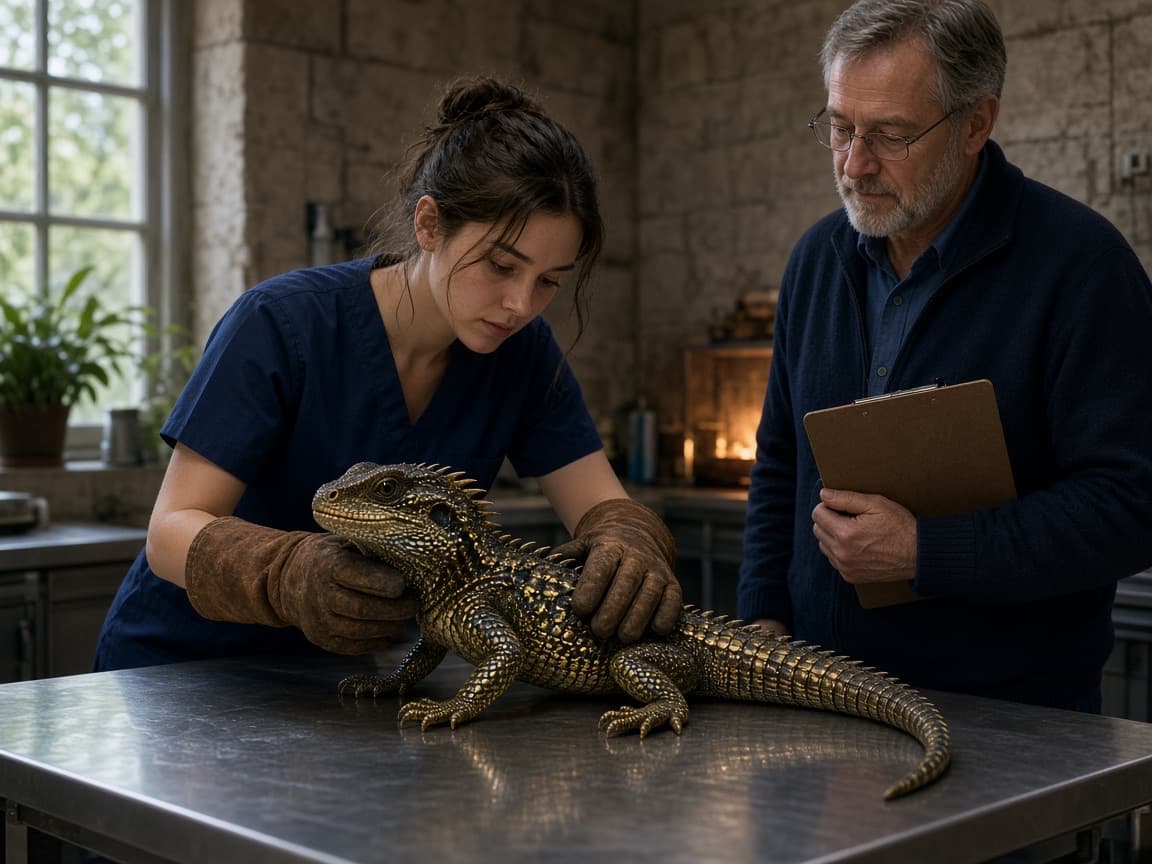
Practicum students on campus work in the Menagerie Hall Teaching Hospital's familiar wellness clinic, where they assist with intake assessments, bond evaluations, and owner education. Many also help coordinate familiar orientation for incoming first-year students, whose Familiar Statements are, each year, among the most widely read documents in the admissions office.
Admission Requirements
Applicants must be at least 18 years old and hold a high school diploma or equivalent. A bachelor's degree is not required. Applicants submit a short statement (500 words) describing their experience with animals and their goals for the program; applicants who have a familiar are invited, but not required, to include a brief Familiar Statement.
Applications are reviewed on a rolling basis for fall and spring starts. Questions? Request information or contact the school directly through the directory.
Frequently Asked Questions
Do I need to have a familiar to enroll?
No. Many students work professionally with familiars without having one themselves, and non-magical students are warmly welcomed. The practicum provides all necessary animal contact.
Can this certificate lead to further study?
Yes. Credits may be applied toward the B.S. in Magical Zoology for students later admitted to the university, and the certificate strengthens applications to the Doctor of Veterinary Thaumaturgy.
Is financial aid available?
Certificate students may be eligible for private education loans and employer tuition assistance. Visit Financial Aid for options.
Sample Courses
| Course | Title | Credits |
|---|---|---|
| ZOOL 410 | Foundations of Familiar Bond Theory | 2 |
| ZOOL 412 | Health and Nutrition for Common Familiars | 2 |
| ZOOL 414 | Behavioral Training and Bond Reinforcement | 2 |
| ZOOL 416 | Familiar Law, Licensing, and Housing | 2 |
| ZOOL 418 | Grief, Rebonding, and Life Transitions | 2 |
| ZOOL 420 | Supervised Bonding Practicum | 2 |
See the full Course Catalog for descriptions and prerequisites.