Research
Rare Ironscale Dragon Hatches at Menagerie Hall
A healthy female Ironscale dragon hatched at Menagerie Hall after a 31-month incubation, the first successful Ironscale hatching at a North American university.
By Office of University Communications · · 4 min read
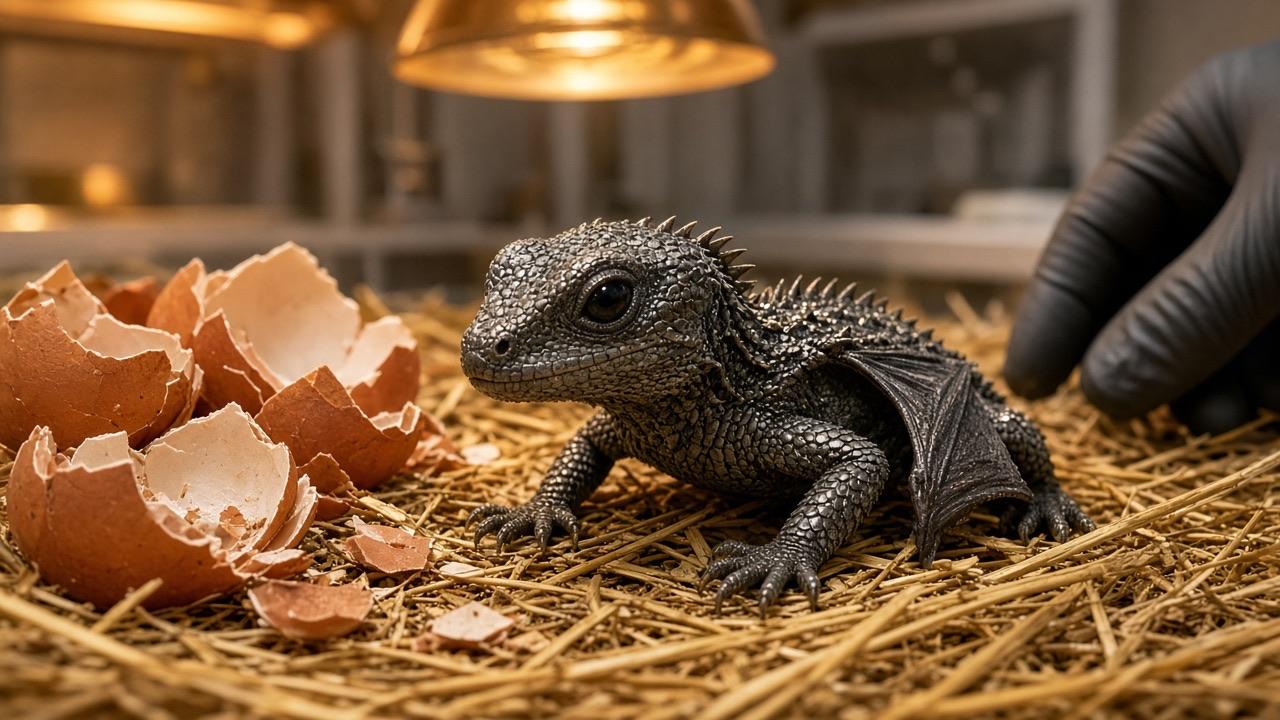
HOLLOWMERE, Vt. — A rare Ironscale dragon hatched early Wednesday morning in the Draconic Incubation Suite at Menagerie Hall, becoming the first of its species ever successfully hatched at a North American university. The hatchling, a female, is healthy, alert, and "already expressing strong opinions," according to the faculty team that oversaw her 31-month incubation.
The hatching occurred at 3:12 a.m. on June 10 after approximately nine hours of visible pipping. The hatchling weighed 11.4 pounds and measured 19 inches from nose to tail. Veterinary staff completed an initial examination by 5:30 a.m. and reported normal respiration, clear eyes, and a flame reflex "consistent with or slightly above species norms."
"This is the culmination of years of patient, careful, and at times extremely hot work," said Dr. Imogen Faraday-Lund, associate professor of Draconic Studies, who led the incubation team. "Ironscale eggs are notoriously difficult. They require sustained temperatures above 1,400 degrees Fahrenheit, precise mineral humidity, and a great deal of listening. We are overjoyed."
A conservation milestone
Ironscale dragons are among the rarest draconic species in the world, with fewer than 200 individuals documented globally. Named for the iron-rich keratin that forms their distinctive gray-black scales, the species is classified as endangered by the International Council on Draconic Conservation. Habitat loss, particularly the closure and collapse of historic mine systems that serve as natural nesting sites, is the primary threat to wild populations.
The egg was recovered in 2023 from a collapsed mine shaft in northern Minnesota and placed in Fablehurst's care under a conservation agreement with state and federal wildlife authorities. The egg had been abandoned; the parent was never located.
"Every Ironscale hatchling represents a measurable increase in the global population," said Dr. Tobias Wren, dean of the School of Magical Zoology & Veterinary Thaumaturgy. "What Dr. Faraday-Lund and her team accomplished here will inform captive incubation protocols around the world. We intend to publish everything."
The science of incubation
Faraday-Lund's team, which included three faculty members, four doctoral students in the Doctor of Veterinary Thaumaturgy program, and nine undergraduates, maintained round-the-clock monitoring for the full incubation period. Among the challenges they addressed:
- Thermal stability. The team worked with the School of Arcane Engineering to design a custom forge-incubator lined with enchanted refractory brick, capable of holding temperature within a two-degree range for months at a time.
- Mineral balance. Ironscale embryos absorb trace metals through the shell. Researchers adjusted iron, manganese, and cobalt concentrations weekly based on shell conductivity readings.
- Acoustic monitoring. Draconic embryos vocalize in the final months of development. The team recorded more than 2,000 hours of pre-hatch audio, which Faraday-Lund described as "a significant new dataset, and also very loud."
Faraday-Lund noted that the incubation suite experienced two unplanned thermal events during the 31 months, neither of which resulted in injury. Her eyebrows are expected to regrow fully by the start of the fall semester.
Undergraduates on the front line
Undergraduate students in the B.S. in Draconic Studies program played a central role in the project, staffing overnight monitoring shifts and assisting with the daily logging of temperature, humidity, and vocalization data.
"I was on the 1 a.m. shift when the shell started cracking, and I have never moved so fast to wake up a professor in my life," said Malcolm Achebe-Strand '27, a Draconic Studies major. "When she finally broke through and looked around, the whole room went quiet. Then she sneezed a small fireball onto a clipboard, and everybody cheered."
Achebe-Strand and two classmates will co-author the team's forthcoming paper on the hatching, expected to be submitted to the Journal of Draconic Biology this fall.
What's next for the hatchling
The hatchling will remain in the Draconic Incubation Suite for at least eight weeks, where she will be fed a diet of ground ore, iron-fortified protein, and small amounts of coal. Veterinary staff will monitor her weight, scale development, and flame output daily.
In keeping with Menagerie Hall policy, the hatchling will not be named by staff. Naming rights are reserved for the dragon herself, who is expected to communicate a preference at approximately 18 months of age. Until then, she is referred to in official records as "Ironscale Hatchling 2026-01" and, informally, as "Ma'am."
Menagerie Hall will not offer public viewings this summer. Faculty expect to share updates, including photographs and video, through university channels as the hatchling grows.
About Draconic Studies at Fablehurst
Fablehurst's Draconic Studies program is one of only a handful of accredited undergraduate programs in the field and offers students hands-on experience in dragon husbandry, behavior, conservation biology, and fire safety. Students may also pursue the Certificate in Familiar Care & Bonding or continue to graduate study in Cryptid Conservation.
Learn more about Dr. Faraday-Lund's research on her faculty profile, or explore research across the university at Research at Fablehurst.
- ironscale dragon
- draconic studies
- menagerie hall
- conservation
- research