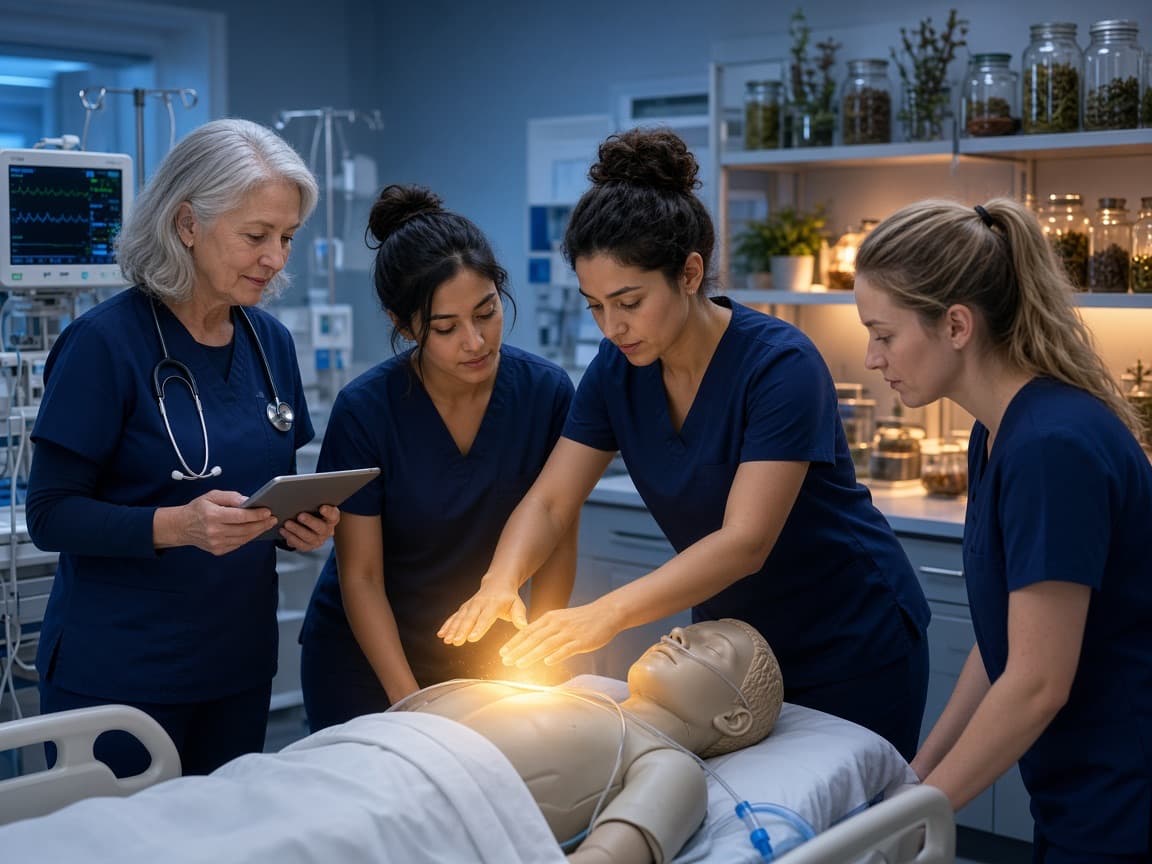
Program Overview
A patient arrives with a fever, fatigue, and a faint silver discoloration of the fingertips. Is it an infection, a reaction to a potion, a slow-acting curse, or all three? Doctors of Healing Arts are trained to find out.
The D.H.A. is a four-year professional doctorate offered by the School of Healing Arts. It is the only degree of its kind in New England, and it prepares physicians for licensed practice in both conventional medicine and the healing arts. Graduates enter residency training in fields ranging from family practice and pediatrics to emergency counter-curse medicine and restorative surgery.
The program enrolls 64 students per year in a close-knit cohort. Under the leadership of Dean Dr. Evander Quill, it emphasizes clinical excellence, scientific rigor, and compassionate care for patients who are frequently frightened and occasionally transfigured.
What You'll Learn
Years one and two (pre-clinical) integrate biomedical science with the study of the body's energetic systems. Students learn anatomy, physiology, and pathology alongside aura diagnostics, therapeutic potioncraft, and the principles of restorative enchantment. Clinical skills training begins in the first month.
Year three consists of core clerkships in internal healing arts, surgery, pediatrics, obstetrics, psychiatry, family practice, and neurology.
Year four includes the required Counter-Curse Medicine Clerkship, acting internships, electives, and a scholarly capstone. Students sit for Steps 1 and 2 of the United States Healing Arts Licensing Examination (USHALE) during the program.
Hands-On Learning
D.H.A. students complete clerkships at Hollowmere Regional Medical Center, Green Mountain Children's Hospital, and affiliated sites throughout Vermont and New Hampshire. Students also volunteer in the student-run Lantern Free Clinic, which serves uninsured residents of the Hollowmere area every Thursday evening.
Research opportunities are available in every year. Recent student projects have examined the long-term outcomes of petrification reversal, the pharmacology of feverfew-based tinctures with Dr. Beatrix Holloway, and patient-reported outcomes following curse removal.
The program will move into the $120 million Quill Center for Healing Arts, now under construction, when it opens in 2028.
Admission Requirements
Applicants must hold a bachelor's degree and have completed:
- One year each of biology, general chemistry, organic chemistry, and physics, all with labs
- One semester of biochemistry
- Coursework in statistics and the social sciences
Applicants submit the MCAT or the Healing Arts College Admission Test (HACAT), along with transcripts, a personal statement, three letters of recommendation, and documented clinical or service experience. Selected applicants are invited to interview. Applications open in June and close November 1. Apply through graduate admissions.
Frequently Asked Questions
Can non-magical students become Doctors of Healing Arts?
Yes. About 30% of each class is non-magical. Graduates practice the full scope of conventional medicine and use prepared remedies and certified instruments for restorative procedures.
How is the D.H.A. different from an M.D.?
The D.H.A. includes the full biomedical curriculum plus roughly 900 additional hours in the healing arts. Graduates are eligible for residency programs that accept both degrees.
Is financial aid available?
Yes. Most students receive aid, and the School offers service scholarships for graduates who commit to practice in rural communities. See financial aid or request information.
Sample Courses
| Course | Title | Credits |
|---|---|---|
| HEAL 701 | Foundations of the Body and Its Energies | 12 |
| HEAL 712 | Pathology, Including Maladies of Arcane Origin | 10 |
| HEAL 720 | Clinical Restorative Enchantment | 8 |
| HEAL 735 | Therapeutic Potioncraft and Pharmacology | 8 |
| HEAL 750 | Clinical Skills and the Healer-Patient Relationship | 6 |
| HEAL 810 | Core Clinical Clerkships | 48 |
| HEAL 850 | Counter-Curse Medicine Clerkship | 6 |
| HEAL 890 | Scholarly Capstone | 6 |
See the full Course Catalog for descriptions and prerequisites.