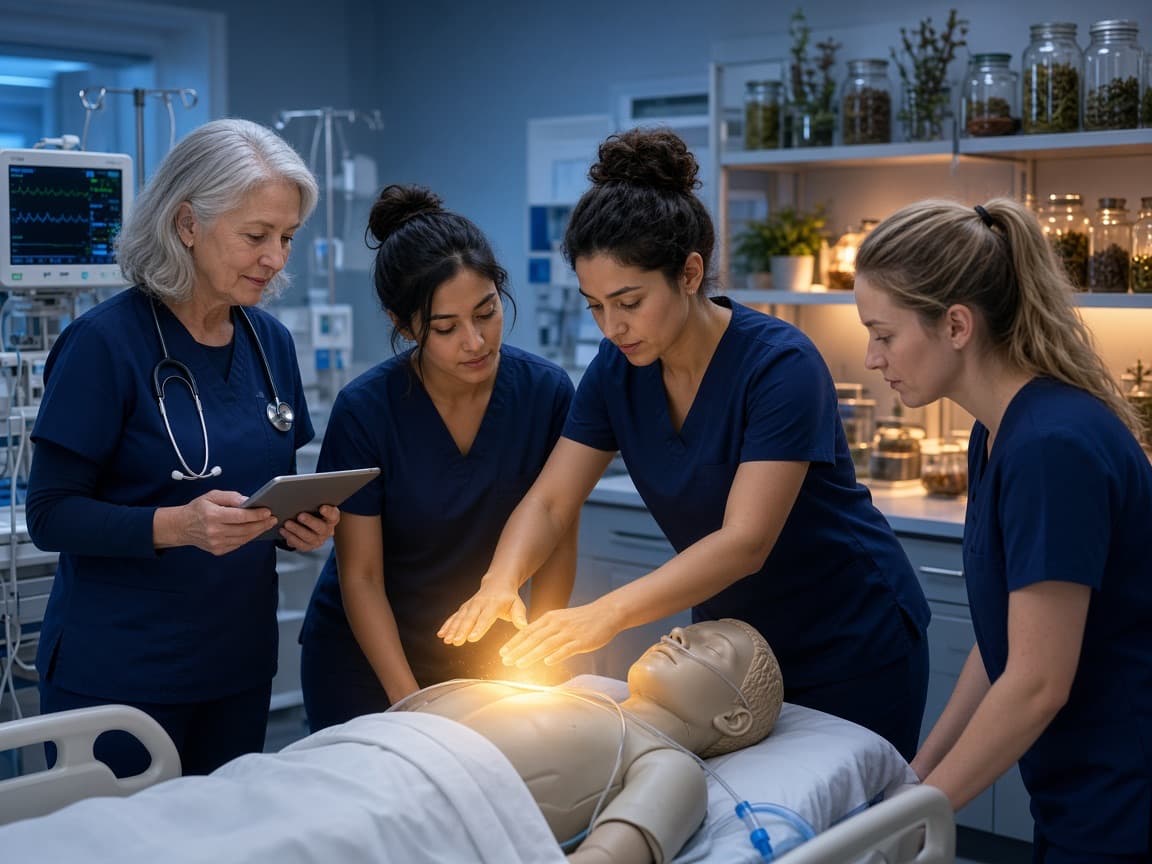
Educating nurses, healers, and counter-curse specialists who combine evidence-based medicine with the healing arts — and who are ready for whatever walks in.
About the School
The School of Healing Arts was founded in 1719, when an outbreak of what contemporary records call "the Hollowmere Glimmering" persuaded the young college that it could no longer rely on a single visiting herbalist. Since then, the School has grown into one of the nation's most respected institutions for integrated care, preparing nurses, doctors of healing arts, herbal medicine specialists, and emergency counter-curse responders.
The School enrolls approximately 760 undergraduates and 290 graduate and professional students. Our 52 full-time faculty include practicing clinicians, researchers, pharmacognosists, and specialists in the treatment of hexes, enchantment injuries, and creature-related trauma. What unites them is a commitment to evidence: every remedy we teach, whether it involves a scalpel, a tincture, or a counter-curse, is held to the same standard of proof.
A School in Transition
The School is currently housed in Aldercroft Hall, a 1920s Colonial Revival building on the north side of campus that served for several decades as the university infirmary. Aldercroft includes simulation suites, a skills laboratory, a teaching apothecary, and a counter-curse training room, and it has served the School faithfully despite what faculty affectionately call "character" (including a radiator that hums in minor keys).
In April 2026, the university broke ground on the $120 million Quill Center for Healing Arts. When it opens in 2028, the Quill Center will more than double the School's teaching space, with a 40-bed simulation hospital, dedicated counter-curse response bays, research laboratories, and a rooftop medicinal garden. Until then, students and faculty will continue to learn, teach, and care for patients at Aldercroft, and we invite prospective students to follow the construction's progress when they visit campus.
Research and Clinical Learning
Healing Arts students complete clinical rotations at 85 partner sites across Vermont, New Hampshire, and Massachusetts, including regional hospitals, rural clinics, long-term care facilities, and the university's own Student Health Center (see Health and Wellness). Graduate students in herbal medicine study and cultivate medicinal plants in the Verdance Conservatories under the guidance of faculty such as Dr. Beatrix Holloway.
The School collaborates closely with the School of Alchemical & Potionary Sciences on potion pharmacology, with the School of Magical Zoology & Veterinary Thaumaturgy on cross-species and creature-related injuries, and with the School of Law & Contract Magic, whose Curse Victims Legal Clinic frequently refers clients for medical evaluation. Faculty research areas include hex pathology, long-term effects of enchantment exposure, and integrative pain management.
Students in the emergency counter-curse program also train alongside Campus Safety & Ward Maintenance, and certified students may serve as volunteer first responders at major campus events, including Skyball matches at Emberfield.
Message from the Dean
"Healing is the oldest of the arts, and still the most humbling. Our students learn to listen carefully, act decisively, and never assume that the obvious diagnosis is the only one. A new building will give us more room to do that work. It will not change why we do it." — Dr. Evander Quill, Dean
Accreditation and Outcomes
The School's nursing and doctoral programs are accredited by the Commission on Collegiate Healing Arts Education. In 2026, graduates earned a 98 percent first-time pass rate on the national nursing and healing arts licensure examination, and 97 percent of graduates were employed in a clinical role within six months. Request information or review undergraduate admissions requirements to begin your application.