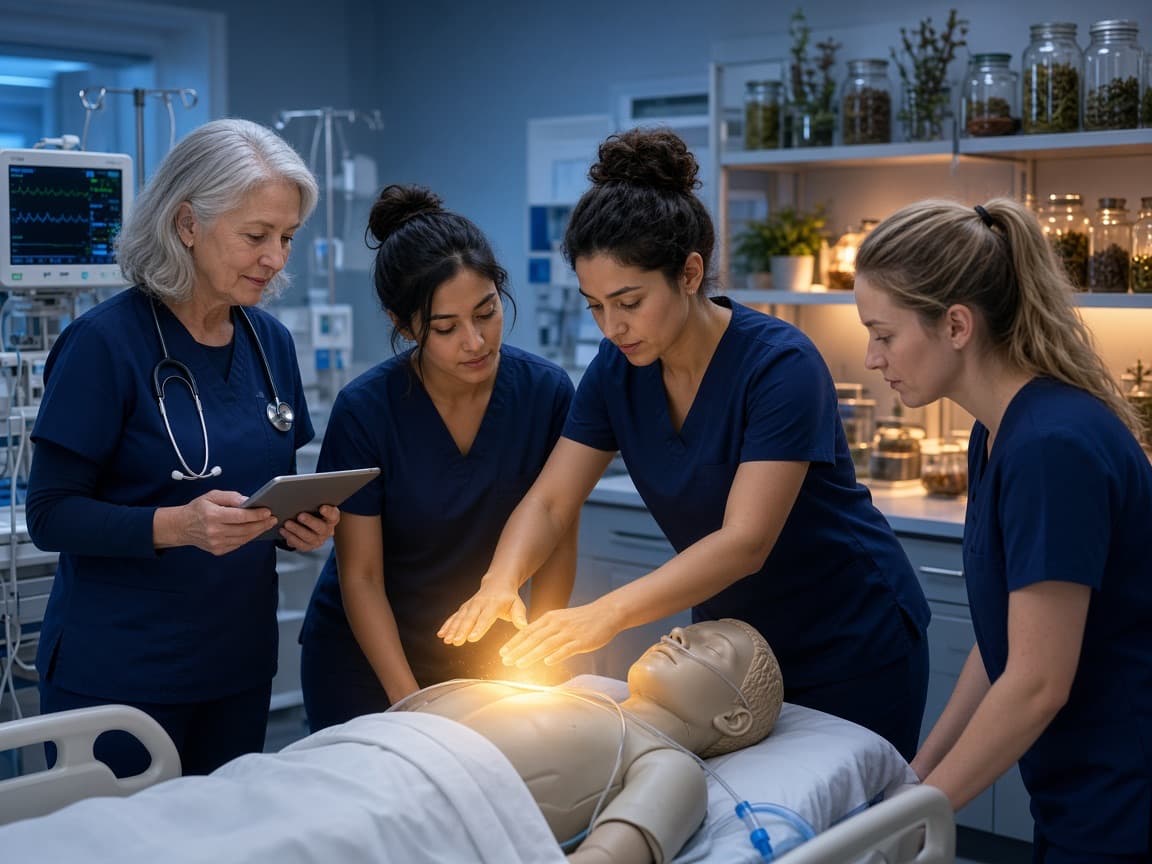
Program Overview
Nearly half of the remedies in use in the healing arts today began as plants. Some still grow wild in the Green Mountains. Others grow only in carefully managed conditions, at particular phases of the moon, and object loudly when harvested. The M.S. in Herbal & Botanical Medicine teaches students to understand, cultivate, and use them safely.
Offered by the School of Healing Arts and directed by Dr. Beatrix Holloway, this two-year, 40-credit program combines rigorous plant science with clinical training. Students choose between a research track, culminating in a thesis, and a clinical track, culminating in a supervised practicum in patient consultation.
The program is built around the Verdance Conservatories, one of the most extensive collections of medicinal and enchanted plants in North America, with more than 3,200 species under glass.
What You'll Learn
Graduates can:
- Identify medicinal plants in the field and in the conservatory, including look-alike species that are harmless, useful, or extremely dangerous
- Explain the chemistry of active compounds and how enchantment alters their potency and behavior
- Cultivate sensitive species under controlled conditions, including those that require silence, moonlight, or regular conversation
- Evaluate evidence on botanical therapies with the same rigor applied to conventional pharmaceuticals
- Counsel patients on safe use, dosing, and interactions with prescribed potions and medications
Hands-On Learning
Every student is assigned a bench and a growing plot in the Verdance Conservatories in their first semester and is responsible for it for two years. Students rotate through the Conservatories' propagation houses, the drying and extraction lab, and the Nocturnal House, which opens only after dark.
Clinical-track students complete 300 hours of supervised consultation at the Student Health Service's integrative clinic and at partner apothecaries in Vermont. Research-track students join active projects; current work in Dr. Holloway's lab includes a study of cold-hardy feverfew cultivars and a long-term trial of willowbark preparations for chronic pain.
Each fall, students also lead a foraging and plant-identification walk for the community during Homecoming & Family Weekend.
Admission Requirements
Applicants should hold a bachelor's degree in biology, botany, chemistry, nursing, or a related field, with at least one course each in organic chemistry and plant biology. Apply through graduate admissions with:
- Transcripts from all institutions attended
- A statement of purpose indicating your preferred track
- Two letters of recommendation
- A résumé
- GRE scores (optional)
The priority deadline is January 15. Research-track applicants are considered for graduate assistantships that include a tuition waiver and stipend.
Frequently Asked Questions
Does this degree lead to licensure?
The M.S. does not by itself confer a clinical license. Graduates who are already licensed nurses or physicians may add botanical therapies to their practice within their scope, and all graduates are eligible for the national Registered Clinical Herbalist credential.
How does this program relate to the alchemy school?
Many courses are open to students in the School of Alchemical & Potionary Sciences, and several students each year pursue research at the intersection of botany and potion pharmacology.
Are the plants safe to work with?
With training, yes. Protective equipment is provided, and ear protection is required in the vocal species greenhouse. Request information to schedule a Conservatories tour.
Sample Courses
| Course | Title | Credits |
|---|---|---|
| HEAL 520 | Medicinal Botany and Plant Identification | 4 |
| HEAL 528 | Phytochemistry and Enchanted Compounds | 4 |
| HEAL 535 | Clinical Herbalism and Patient Consultation | 4 |
| HEAL 542 | Cultivation of Sensitive and Vocal Species | 3 |
| HEAL 556 | Research Methods in Botanical Medicine | 3 |
| HEAL 564 | Toxicology, Interactions, and Botanical Safety | 3 |
| HEAL 590 | Master's Thesis or Clinical Practicum | 6 |
See the full Course Catalog for descriptions and prerequisites.