Program Overview
A potion is only as good as its evidence. The Bachelor of Science in Potion Pharmacology trains students to understand exactly what happens after a preparation leaves the cauldron: how it is absorbed, how long it lasts, what it interacts with, and why a tincture that cures hiccups in a human may cause a griffin to speak fluent Portuguese for several hours.
Housed in the School of Alchemical & Potionary Sciences, the major is designed as a pre-professional pathway. Roughly half of our graduates go directly into industry; the rest continue to pharmacy licensure programs, research degrees, or professional study in the School of Healing Arts.
What You'll Learn
Potion Pharmacology is built around three questions every practitioner must be able to answer:
- Is it effective? Students learn potion kinetics, steeping dynamics, and dose-response modeling, and they design and analyze controlled trials.
- Is it safe? Coursework in adverse effects, contraindications, and antidote chemistry is required, not elective. Students graduate knowing how to read — and write — a potion safety data sheet.
- Is it consistent? Batch variation is the enemy of good medicine. ALCH 260 teaches standardization against the Standard Cauldron, the national reference vessel maintained in Crucible Hall since 1887.
Students also complete supporting coursework in biology, organic chemistry, statistics, and botany, much of it taken alongside pre-healing students.
Hands-On Learning
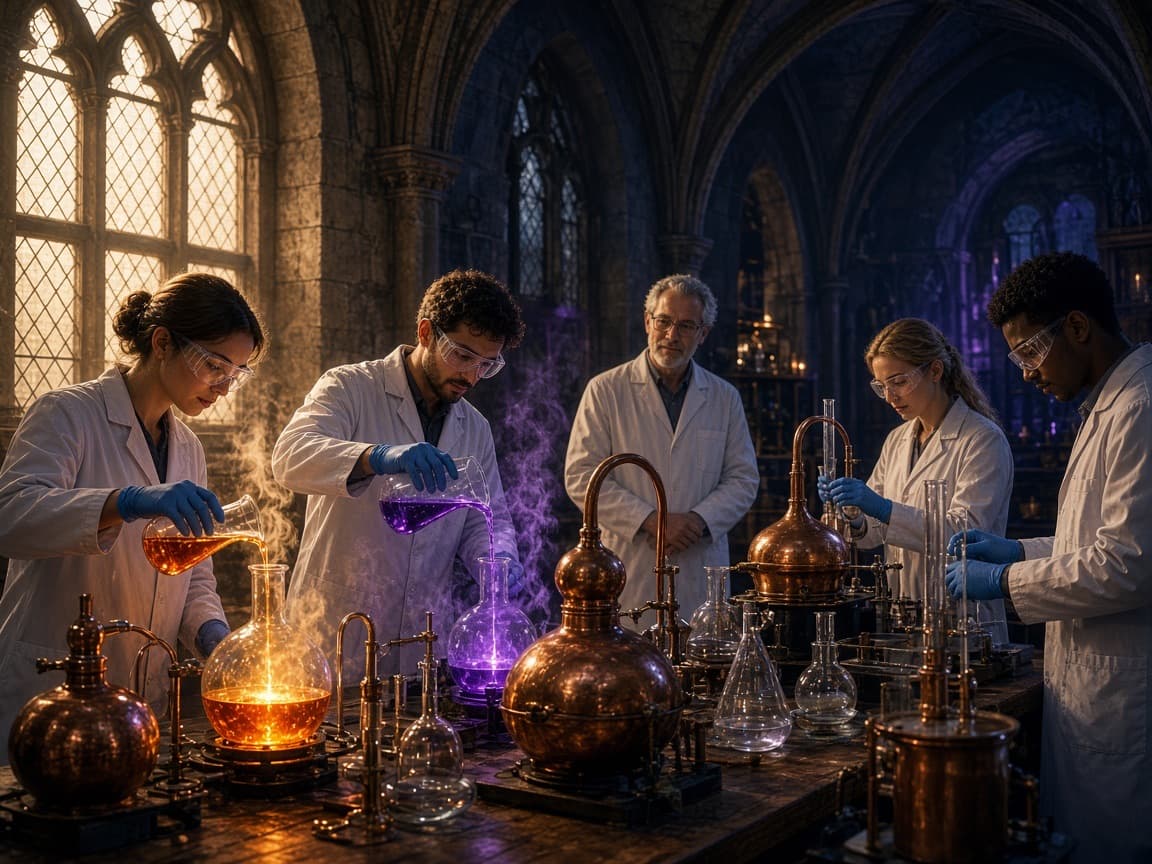
Laboratory work begins in the first semester. By senior year, every student has brewed, assayed, and documented more than 150 preparations. Key experiences include:
- The Verdance Conservatories, where students cultivate their own reagent herbs under the guidance of horticultural staff.
- Apothecary rotations at partner compounding pharmacies across New England, completed during the junior year.
- Undergraduate research in the lab of Dr. Hana Okonkwo-Price, whose group studies long-acting restorative draughts and the pharmacology of sleep potions.
Beginning in 2028, seniors will complete clinical observation hours at the new Quill Center for Healing Arts, now under construction on the north side of campus.
Admission Requirements
There is no separate application to the major; students are admitted to Fablehurst through the first-year application and declare Potion Pharmacology when ready. Strong candidates generally present:
- Four years of science, including biology and chemistry
- Mathematics through precalculus (calculus preferred)
- Volunteer, work, or shadowing experience in a healthcare, apothecary, or laboratory setting (recommended, not required)
Transfer students should review transfer admission guidelines early, as the major's lab sequence begins in the fall.
Frequently Asked Questions
Is this a good major for students planning a career in healing?
Yes. Potion Pharmacology satisfies nearly all prerequisites for the Doctor of Healing Arts and the M.S. in Herbal & Botanical Medicine. Our pre-professional advisors meet with every major each semester.
Do students test potions on themselves?
No. All human-subject work follows protocols approved by the university's Institutional Review Board, and self-administration is prohibited under the student code of conduct. This is, historically, how most of the school's safety rules came to exist.
What if I'm more interested in the business side?
Many graduates move into production and distribution. Consider pairing the major with coursework from the Merriweather School and, later, the M.S. in Potion Supply Chain Management.
Sample Courses
| Course | Title | Credits |
|---|---|---|
| ALCH 105 | Introduction to Potionary Science | 4 |
| ALCH 140 | Botanical Reagents and Their Cultivation | 3 |
| ALCH 225 | Potion Kinetics and Steeping Dynamics | 4 |
| ALCH 260 | Dosage, Potency, and the Standard Cauldron | 3 |
| ALCH 330 | Clinical Potion Trials | 4 |
| ALCH 355 | Adverse Effects, Interactions, and Antidotes | 4 |
| ALCH 440 | Pharmacopotionary Capstone | 4 |
See the full Course Catalog for descriptions and prerequisites.