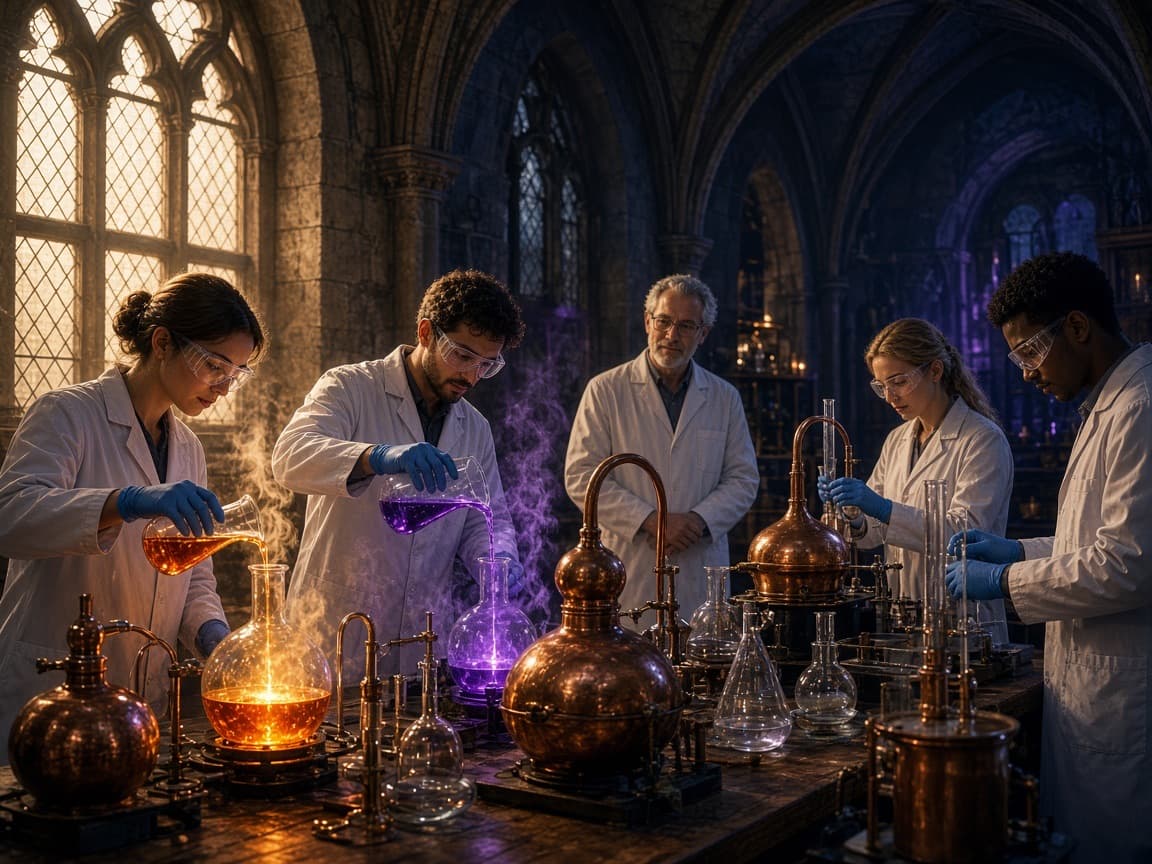
Program Overview
For more than three centuries, Fablehurst has taught students to change one thing into another — carefully, reproducibly, and with the appropriate paperwork. The Bachelor of Science in Alchemical Sciences is the flagship undergraduate major of the School of Alchemical & Potionary Sciences, and one of the few programs in the country accredited to award a degree in transmutation.
Our approach is unapologetically empirical. Alchemy has a long and colorful history, and students will study it, but our graduates leave able to design an experiment, measure its yield, document its failure modes, and explain the results to a skeptical review board. That combination of classical tradition and modern scientific discipline is why employers and graduate programs recruit from Crucible Hall year after year.
What You'll Learn
The curriculum moves from first principles to independent research over eight semesters:
- Years one and two build a common foundation in transmutation theory, reagent chemistry, and the four-element correspondence model, alongside required coursework in mathematics, physics, and writing.
- Year three introduces quantitative transmutation — the measurement of essence, mass, and residual instability — as well as the program's required ethics seminar, ALCH 345, which addresses gold conversion, market disruption, and federal reporting obligations under the Aurum Stability Act.
- Year four culminates in the Senior Crucible Project, a year-long research effort presented publicly each April.
Students also choose 16 credits of upper-division electives in areas such as stable-state metallurgy, alchemical botany, or the history of the Great Work. Many pair the major with a minor in Potion Pharmacology or arcane engineering.
Hands-On Learning
Alchemical Sciences majors spend more time at the bench than almost any other undergraduates at Fablehurst — an average of nine laboratory hours per week by junior year. Facilities include:
- The Crucible Hall teaching laboratories, with 64 individually warded workstations and continuous fume extraction.
- Dedicated growing beds in the Verdance Conservatories for students working with botanical reagents.
- The Crucible Scholars summer research program, which funds 20 undergraduates each year to work full-time in faculty labs.
Juniors are strongly encouraged to complete a summer internship. Recent placements include precious-metals refineries, national materials laboratories, museum conservation departments, and regulatory agencies.
Admission Requirements
Students apply to Fablehurst through the standard first-year process using The Common Scroll or the Fablehurst Application; there is no separate application to the major. Successful applicants typically have completed:
- Four years of mathematics, including precalculus
- At least one year of laboratory chemistry (physics is recommended)
- Strong written communication skills
Magical ability is not required. Non-magical students succeed in this major and routinely perform transmutations using calibrated catalytic instrumentation. Visit Undergraduate Admissions for deadlines and details, or request information to connect with the school.
Frequently Asked Questions
Will I learn to make gold?
Yes, in a supervised, small-quantity, fully documented setting. Gold transmutation is covered in ALCH 310 and is subject to university policy and federal reporting limits. Students may not remove gold from the laboratory, and all product is returned to the Bursar's vault.
What is the difference between this major and Potion Pharmacology?
Alchemical Sciences focuses on the transformation of matter itself; Potion Pharmacology focuses on preparations intended for living bodies. The first two semesters overlap substantially, so students can switch between them without losing time.
Who teaches the introductory courses?
Full-time faculty. Dean Ignatius Crane-Muller has taught ALCH 101 every fall since 2004 and considers it the most important course in the school.
Sample Courses
| Course | Title | Credits |
|---|---|---|
| ALCH 101 | Foundations of Transmutation | 4 |
| ALCH 120 | Reagent Chemistry and Safe Handling | 4 |
| ALCH 215 | Elemental Correspondences | 3 |
| ALCH 230 | Calcination, Distillation, and Sublimation Techniques | 4 |
| ALCH 310 | Quantitative Transmutation | 4 |
| ALCH 345 | Alchemical Ethics and the Gold Question | 3 |
| ALCH 420 | Senior Crucible Project | 4 |
See the full Course Catalog for descriptions and prerequisites.