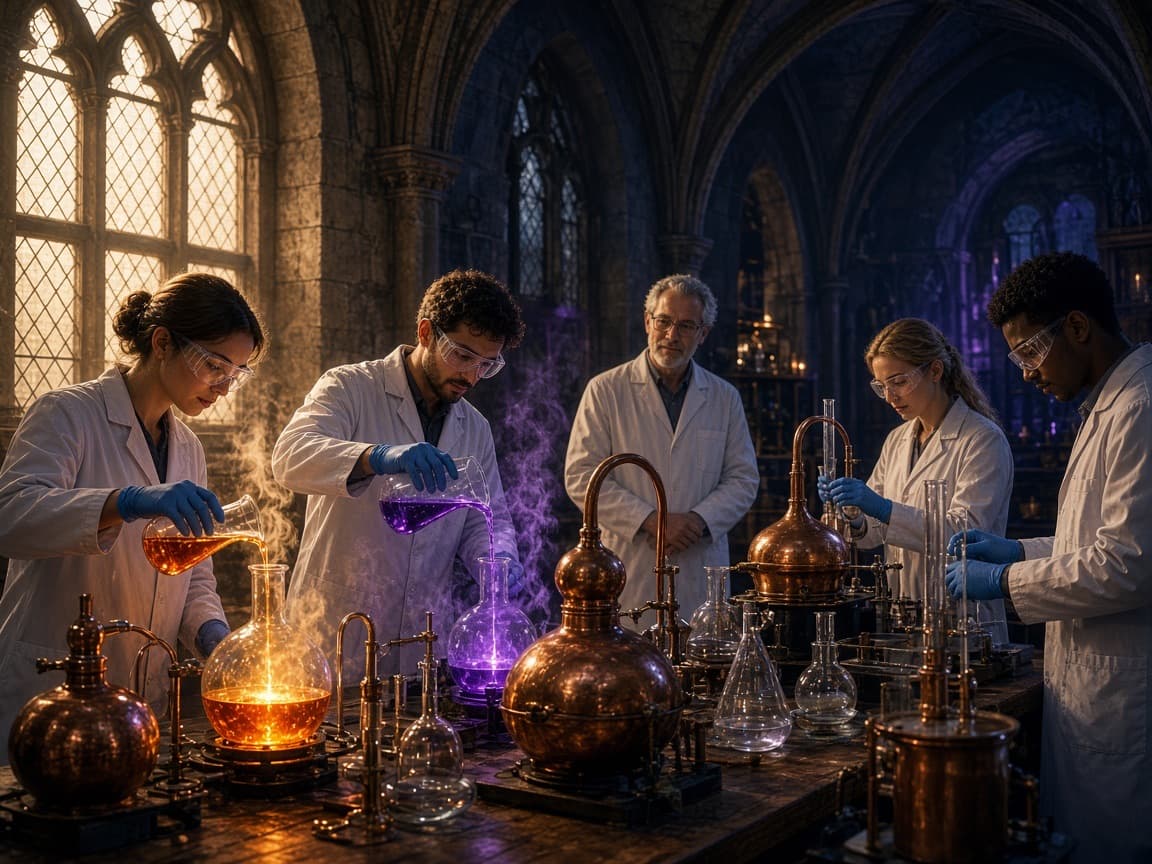
One of Fablehurst's founding disciplines, pairing rigorous transmutation research with modern potion pharmacology and an uncompromising culture of lab safety.
About the School
Established in 1702, less than a decade after Elspeth Fablehurst opened the doors of the Collegiate School of the Hidden Arts, the School of Alchemical & Potionary Sciences is one of the university's founding disciplines — and, by any reasonable measure, its most carefully ventilated. For more than three centuries, our faculty and students have pursued a deceptively simple question: what is matter, and what else might it be persuaded to become?
Today the School enrolls approximately 540 undergraduates and 190 graduate students, supported by 46 full-time faculty whose expertise spans theoretical transmutation, reagent chemistry, potion pharmacology, and the emerging field of alchemical ethics. Our graduates go on to lead research laboratories, regulate the national potion supply, develop life-saving elixirs, and, in at least one well-documented case, win the Ormond Prize for Transmutation — congratulations again to Dr. Wilhelmina Ashcombe '98.
Research and Facilities
The School is headquartered in Crucible Hall, a four-story limestone building completed in 1874 to replace the original laboratory following what university records describe as "the Great Effervescence of 1873." A $64 million renovation completed in 2019 added 14 blast-rated teaching laboratories, a climate-controlled reagent vault, a dedicated distillation tower, and what our facilities team believes to be the most advanced fume-extraction system in New England.
Faculty and students conduct research through two principal units:
- The Center for Stable Transmutation, which studies how transmuted materials can be made to stay transmuted — a problem that has frustrated practitioners since antiquity and continues to frustrate our insurers.
- The Potion Pharmacology Research Unit, led in part by Dr. Hana Okonkwo-Price, which works closely with the School of Healing Arts on dosage standards, shelf stability, and clinical trials.
Botanical reagents are cultivated in the nearby Verdance Conservatories, and School researchers are proud contributors to the university's dragonfire heat recovery initiative, developing catalytic linings that capture waste heat from Menagerie Hall. Learn more about the university's broader research enterprise at Research at Fablehurst.
Student Experience
Alchemy students work in the lab from their very first semester. Every incoming student completes the School's Brewing Safety Orientation before touching a cauldron, and by the end of the first year most have logged more than 120 supervised laboratory hours.
Undergraduate research is not an add-on here; it is the norm. More than 70 percent of our majors complete a faculty-mentored research project before graduation, and many present at the School's annual Spring Symposium on Transmutation, held each April in the Crucible Hall atrium. Students also gather through the Crucible Society, one of the oldest student organizations on campus, which hosts reagent swaps, study nights, and a much-anticipated end-of-semester cook-off (non-potable entries are judged separately). Explore more at Clubs and Organizations.
Message from the Dean
"Alchemy has always been a discipline of patience, precision, and humility. The materials do not care how talented you are; they care whether you measured correctly. At Fablehurst, we teach students to respect that truth, to work safely and ethically, and to ask questions that have not yet been asked. I invite you to visit Crucible Hall and see what our students are brewing." — Prof. Ignatius Crane-Muller, Dean
Outcomes
Within six months of graduation, 94 percent of the School's undergraduates are employed or enrolled in graduate or professional study. Recent graduates have joined national potion manufacturers, state apothecary boards, hospital pharmacies, metallurgical firms, and doctoral programs at Fablehurst and peer institutions. The School's professional programs are accredited by the American Council for Potionary Education, and the university as a whole is accredited by the New England Commission of Higher Enchantment. See Accreditation for details.
Ready to take the next step? Request information or plan a visit to tour Crucible Hall in person.