Alumni
Alumna Dr. Wilhelmina Ashcombe '98 Awarded the Ormond Prize for Transmutation
Dr. Wilhelmina Ashcombe '98, whose work solved transmutation reversion, has won the Ormond Prize, the field's highest honor. She began in Crucible Hall.
By Office of Alumni Relations · · 4 min read
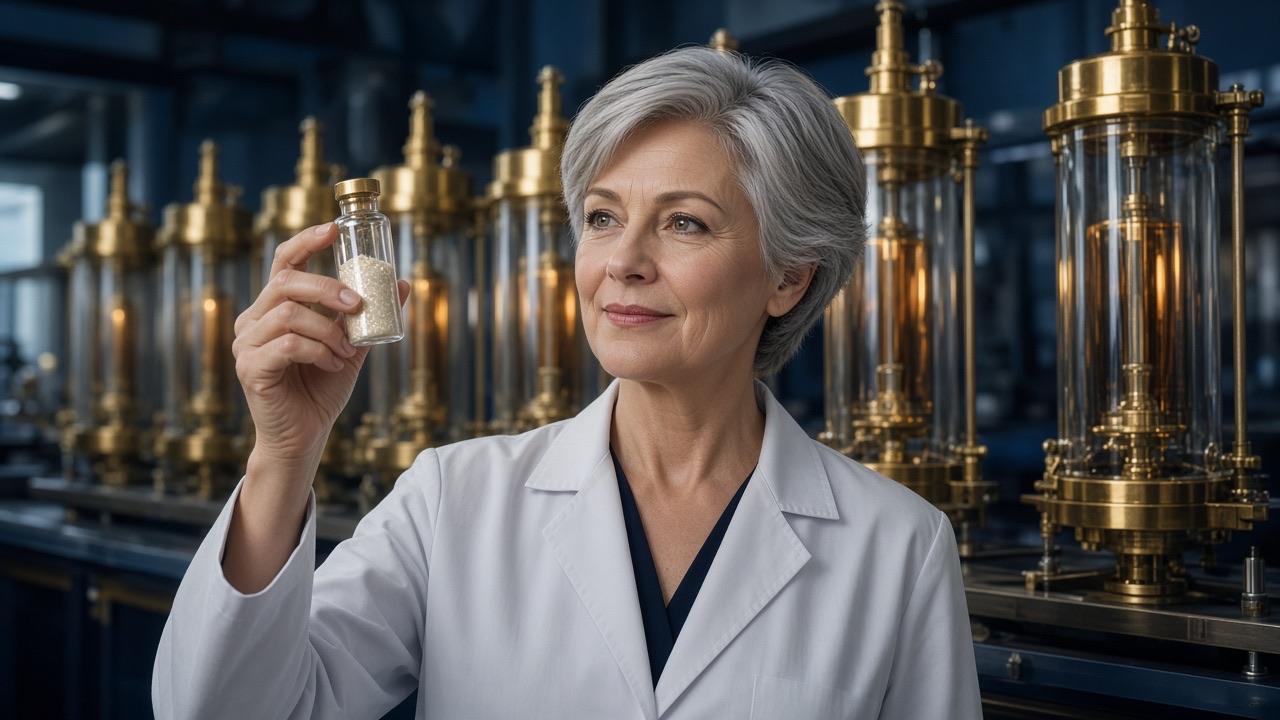
Somewhere in Crucible Hall, in a second-floor teaching lab that has since been renovated twice, there is a lab bench made entirely of white marble. It was not always marble. A small brass plaque on its side reads: W. Ashcombe, Class of 1998. Unintentional.
This week, the student responsible for that bench received the highest honor in her field.
Dr. Wilhelmina Ashcombe '98, a graduate of Fablehurst's B.S. in Alchemical Sciences program, has been named the 2026 recipient of the Ormond Prize for Transmutation, awarded by the International Society for Transmutative Sciences. The prize, first presented in 1924, recognizes research that has "fundamentally advanced the science and responsible practice of transmutation" and carries an award of $250,000.
Ashcombe is the fourth Fablehurst graduate to receive the Ormond Prize and the first since 1981.
Solving the reversion problem
For most of the history of alchemy, transmutation has come with an asterisk. Materials converted from one substance to another tend, over time, to revert — sometimes in days, sometimes in decades, and almost always at an inconvenient moment. The phenomenon, known as reversion, has limited transmutation's usefulness in construction, manufacturing, and medicine for centuries.
Ashcombe's work changed that. In a series of papers beginning in 2014, she identified the mechanism behind reversion — a slow "memory leak" in the transmuted material's underlying structure — and developed a room-temperature stabilization process that extends the reversion half-life of treated materials from an average of seven years to an estimated 4,000.
The practical applications have been significant. Her laboratory's process is now used at facilities in six countries to convert non-recyclable plastic waste into inert mineral feedstock for construction, diverting an estimated 310,000 tons of plastic from landfills in 2025 alone.
"Dr. Ashcombe took the oldest unsolved problem in our discipline and solved it with patience, rigor, and an almost unreasonable commitment to careful measurement," said Prof. Ignatius Crane-Muller, dean of the School of Alchemical & Potionary Sciences. "She was also, and I say this with great affection, the most exciting student to have in a teaching lab in my entire career. Exciting in several senses."
A Fablehurst beginning
Ashcombe grew up in Bangor, Maine, the daughter of a high school chemistry teacher and a harbor pilot. She arrived at Fablehurst in 1994 and was assigned by Provost Emeritus Corvin to Starfell College, where she said she "learned to do my best work between midnight and four in the morning, which I do not recommend, but which I also have not stopped doing."
She enrolled in ALCH 101, Foundations of Transmutation, in her first semester. Her instructor was a young assistant professor named Ignatius Crane-Muller.
"The marble bench happened in week six," Ashcombe recalled in a phone interview from her laboratory. "The assignment was to convert a small sample of copper into brass. I was curious what would happen if I adjusted the catalyst ratio. What happened was the bench. Professor Crane-Muller looked at it for a very long time and then asked me to write up exactly what I'd done. That was the moment I understood this was a place that would rather understand an accident than punish it."
The university elected to keep the bench.
After graduating summa cum laude, Ashcombe earned her Ph.D. in transmutative chemistry at the Royal Institute of Alchemical Research in London. She completed postdoctoral work in Zurich before founding the Ashcombe Laboratory for Stable Transmutation at the Pemberton-Hale Research Institute in Denver, where she has served as director since 2011.
Recognition from the university
"On behalf of the entire Fablehurst community, I offer Dr. Ashcombe our warmest congratulations," said President Dr. Aurelia Thornquist. "Her work is the best possible example of what we hope every Fablehurst graduate will do: take something they learned here, follow it further than anyone expected, and use it to make the world better."
Ashcombe has remained closely connected to the university. She served on the School of Alchemical & Potionary Sciences' Advisory Board from 2015 to 2022, has hosted more than 30 Fablehurst students as summer research interns, and in 2020 established the Ashcombe Undergraduate Research Fund, which supports first- and second-year students conducting independent lab projects.
"I did my internship in her lab last summer, and on my first day she showed me a photo of the marble bench and said, 'Mistakes are data. Please document yours,'" said Esther Mahlangu-Price '27, an Alchemical Sciences major. "I think about that every time I'm in lab."
Advice for current students
Asked what she would tell students beginning their studies in alchemy today, Ashcombe was characteristically direct.
"Measure everything, including the things you think don't matter," she said. "Ask the question you're afraid is stupid. And be kind to your lab partners, because one day you will need them to vouch that the bench was already like that."
Ashcombe will receive the Ormond Prize at a ceremony in Lisbon on October 9. She will return to campus during Homecoming and Family Weekend, October 16–18, to deliver a public talk in Crucible Hall. Details will be shared with alumni in the coming weeks.
Stay connected
Fablehurst alumni can share news, update contact information, and find upcoming events through the Alumni office. To support undergraduate research opportunities like those Dr. Ashcombe championed, visit Give to Fablehurst. Students interested in graduate study in the field can explore the M.S. in Applied Transmutation.
- alumni
- ormond prize
- alchemy
- transmutation
- awards