Program Overview
Transmuting a single ounce of lead in a teaching lab is one thing. Transmuting four metric tons a week, at consistent purity, without destabilizing the surrounding building, is another. The Master of Science in Applied Transmutation prepares experienced professionals to make that leap.
Designed for chemists, materials scientists, engineers, and alchemy graduates already working in the field, the program combines rigorous graduate-level theory with the operational knowledge needed to manage transmutation at scale. The hybrid format lets most students keep their jobs while they study — and bring real problems from their workplaces into the classroom.
What You'll Learn
The 36-credit curriculum is organized around the full lifecycle of an industrial transmutation process:
| Stage | Core course | Key competencies |
|---|---|---|
| Theory | ALCH 510, ALCH 525 | Essence balance, stability thresholds, reversion modeling |
| Scale-up | ALCH 540 | Reactor design, batch vs. continuous conversion, yield optimization |
| Measurement | ALCH 560 | Assay methods, purity certification, residual-instability testing |
| Governance | ALCH 575, ALCH 585 | Federal reporting, market-impact review, incident response |
Students complete nine credits of electives, with options in arcane engineering, supply chain management, and patent law, before finishing with a six-credit applied project or thesis.
Hands-On Learning
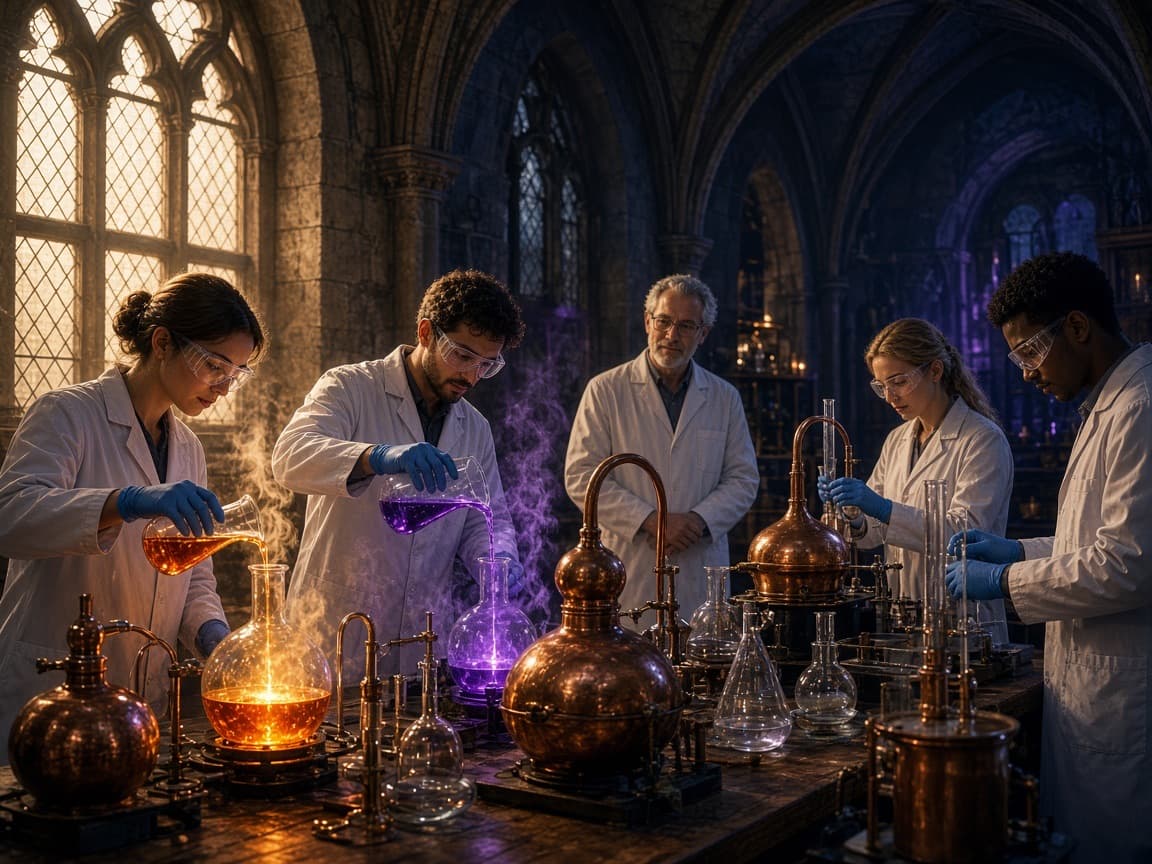
Coursework is delivered online in live evening sessions, supplemented by three one-week residencies in Crucible Hall's pilot-scale transmutation facility — one each in January, June, and the following January. Residencies are intensive: students operate equipment that is not available anywhere else in higher education, including the school's 400-liter continuous-flow athanor.
Most students complete their applied project in partnership with their employer. Others work with faculty on sponsored research. Dean Ignatius Crane-Muller personally supervises a limited number of thesis students each year.
The program's alumni network includes some of the field's most recognized practitioners, among them Dr. Wilhelmina Ashcombe '98, recipient of the 2026 Ormond Prize for Transmutation.
Admission Requirements
Applicants should hold a bachelor's degree in alchemical sciences, chemistry, materials science, chemical engineering, or a closely related field, with a minimum GPA of 3.0. Two or more years of professional experience is strongly preferred. A complete application includes:
- Online application through Graduate Admissions and a $75 fee
- Statement of purpose (750–1,000 words)
- Current résumé
- Two letters of recommendation, at least one from a supervisor
- Official transcripts
The GRE is not required. Priority deadline for fall entry is January 15; the spring deadline is October 1. Students without formal laboratory safety training must complete the Certificate in Advanced Brewing Safety or equivalent before their first residency.
Frequently Asked Questions
Can I really complete this degree while working full-time?
Yes — most of our students do. Part-time students typically take two courses per term and finish in three years. Residency dates are published a full year in advance.
Should I choose the project or the thesis?
Students pursuing leadership roles in industry usually choose the applied project. Those considering the Ph.D. in Alchemy should choose the thesis.
Is financial assistance available?
Many students receive employer tuition support. Federal loans and a limited number of merit scholarships are also available; see Financial Aid for details.
Sample Courses
| Course | Title | Credits |
|---|---|---|
| ALCH 510 | Advanced Transmutation Theory | 3 |
| ALCH 525 | Conservation of Essence | 3 |
| ALCH 540 | Industrial-Scale Transmutation Processes | 3 |
| ALCH 560 | Transmutation Metrology and Assay | 3 |
| ALCH 575 | Regulatory Frameworks for Precious-Metal Conversion | 3 |
| ALCH 585 | Transmutation Risk Management | 3 |
| ALCH 590 | Applied Project or Master's Thesis | 6 |
See the full Course Catalog for descriptions and prerequisites.