Program Overview
The Doctor of Philosophy in Alchemy is the oldest doctoral program at Fablehurst University, awarded continuously since 1894 and — by the reckoning of the university archivist — the longest-running alchemy doctorate in North America. It is intentionally small. Each fall we admit between six and nine students, and every one of them is fully funded for five years.
Doctoral students in the School of Alchemical & Potionary Sciences join a community of scholars working at the frontier of the field: stable transmutation, essence conservation, alchemical pharmacology, and the historical reconstruction of lost procedures. Our graduates go on to lead laboratories, departments, and national research agendas.
What You'll Learn
The program is structured in three phases.
Coursework (Years 1–2). Students complete a core sequence in essence theory, experimental design, and the historiography of the Great Work, along with electives tailored to their research interests. First-year students rotate through three faculty laboratories before selecting an advisor in April.
Candidacy (end of Year 2). The qualifying examination consists of a written research proposal and an oral defense before a committee of four faculty. By long tradition, the exam also includes one practical transmutation chosen by the committee and revealed on the morning of the defense.
Dissertation (Years 3–5). Candidates conduct original research leading to a dissertation that makes a significant and verifiable contribution to the field. At least two peer-reviewed publications are expected prior to the defense.
Hands-On Learning
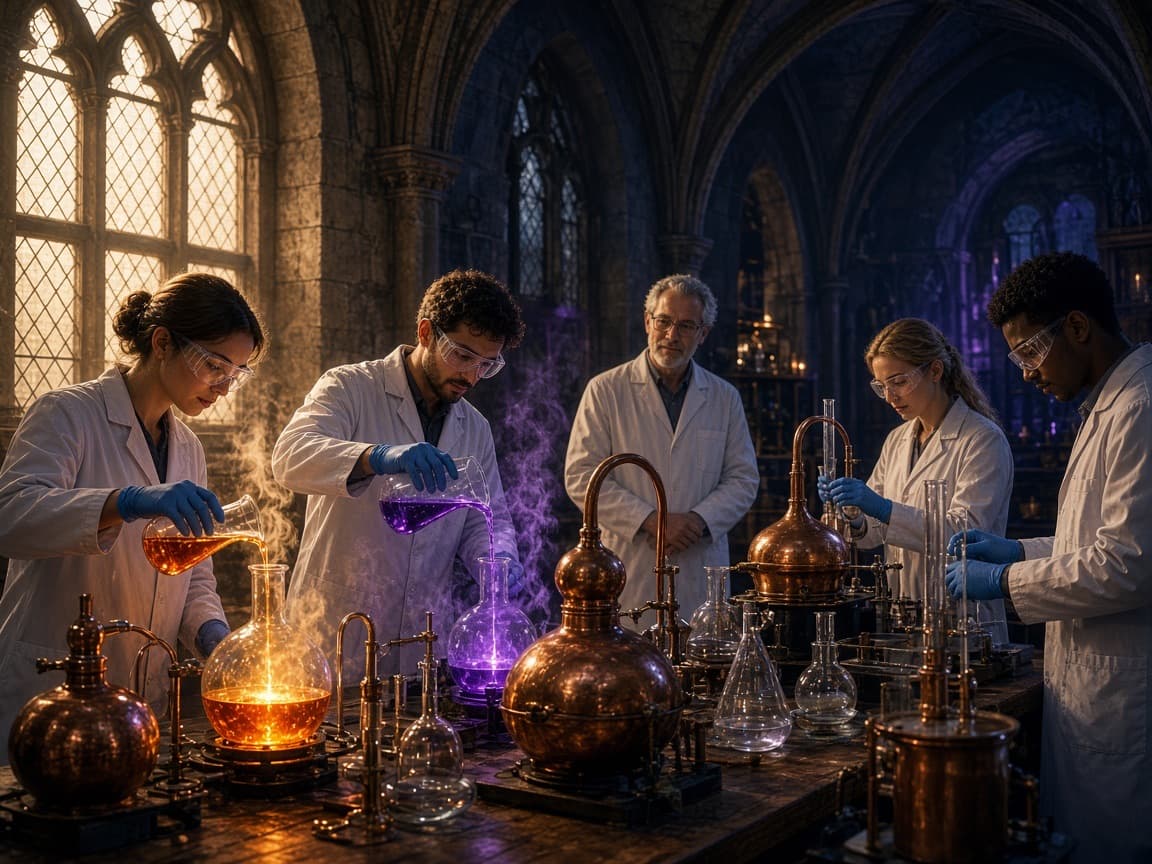
Research is the heart of the doctoral experience. Students have access to Crucible Hall's research wing, including the Deep Crucible — a shielded, below-grade laboratory for high-energy transmutation — and the school's collection of more than 3,000 historical manuscripts, held jointly with Wickham Memorial Library.
Every doctoral student also teaches. Two semesters as a teaching assistant are required, supported by ALCH 760, and many students go on to design and teach an undergraduate elective. Current faculty research groups are led by Dean Ignatius Crane-Muller and Dr. Hana Okonkwo-Price, among others.
Admission Requirements
Applicants must hold a bachelor's degree in alchemy, chemistry, or a related natural science. A master's degree is welcome but not required; many students enter directly from undergraduate study, and some come from our own M.S. in Applied Transmutation.
A complete application includes a statement of research interests, three letters of recommendation, transcripts, a CV, and a writing sample or research report. The GRE is optional. The application deadline for fall 2027 entry is December 15, 2026. Shortlisted applicants are invited to an interview weekend in February, with travel costs covered by the school.
Apply through Graduate Admissions, or attend the Graduate & Professional Open House on November 14.
Frequently Asked Questions
What does the funding package include?
Full tuition remission, health insurance, and an annual stipend of $38,500 for five years, contingent on satisfactory progress. Summer research support and conference travel grants are also available.
Can I pursue a Ph.D. part-time?
No. The program's laboratory and teaching requirements make full-time residence in Hollowmere essential.
Is the practical component of the qualifying exam dangerous?
The committee selects transmutations that are challenging but well within the candidate's demonstrated competence. Campus Safety attends as a formality.
Sample Courses
| Course | Title | Credits |
|---|---|---|
| ALCH 701 | Doctoral Proseminar in Alchemical Research | 3 |
| ALCH 710 | Historiography of the Great Work | 3 |
| ALCH 725 | Advanced Essence Theory | 3 |
| ALCH 740 | Experimental Design in Alchemy | 3 |
| ALCH 755 | Seminar in Stable Transmutation | 3 |
| ALCH 760 | Teaching Alchemy: Pedagogy and Laboratory Supervision | 1 |
| ALCH 899 | Dissertation Research | 12 |
See the full Course Catalog for descriptions and prerequisites.