Biography
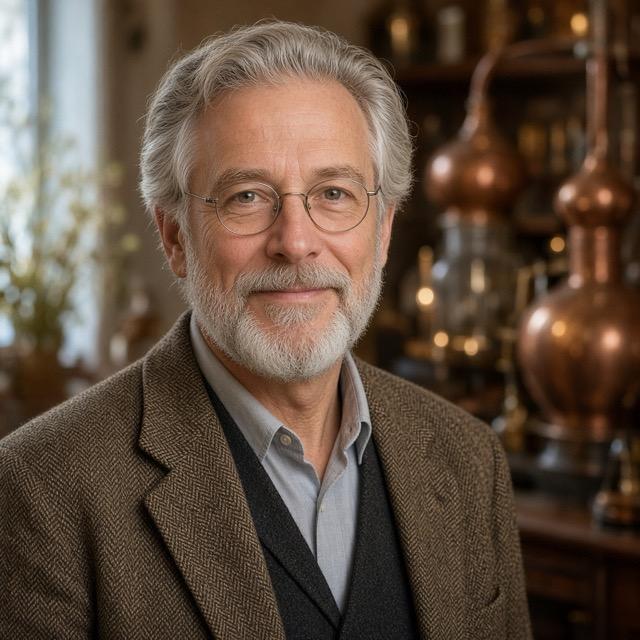
Prof. Ignatius Crane-Muller has served as Dean of the School of Alchemical & Potionary Sciences since 2017 and has been a member of the Fablehurst faculty since 1998. He is internationally recognized for his work on transmutation persistence: the tendency of transmuted materials to revert to their original state over time, usually at the least convenient moment.
Born in Cleveland, Ohio, to a metallurgist father and a pharmacist mother, Crane-Muller studied chemistry at the University of the Western Reach before earning a master's degree in metallurgy in England. He came to Fablehurst for doctoral work in 1991 and completed a dissertation on lead-to-copper stability that remains one of the most cited in the field, largely because its central experiment has never been successfully replicated, including by him.
His laboratory, the Center for Stable Transmutation, has received continuous federal and foundation funding since 2004. The Center's work has informed industrial standards for transmuted structural metals, and in 2022 Crane-Muller testified before a congressional subcommittee on the labeling of transmuted goods in consumer products.
As dean, he oversaw completion of the School's $64 million Crucible Hall renovation and established the Brewing Safety Orientation now required of every incoming alchemy student. He is a vocal advocate for undergraduate research and personally mentored Dr. Wilhelmina Ashcombe '98, whose 2026 Ormond Prize he describes as "the proudest moment of my career, and a reminder that I should have listened to her more closely in 1997."
Crane-Muller is a Fellow of the American Council for Potionary Education and past president of the Northeastern Alchemical Society. He still teaches the School's introductory transmutation course every fall, and he has not missed a lecture in twenty-six years, a streak he attributes to "an excellent immune system and a very good fume hood."
Selected Publications
- Crane-Muller, I. (2024). "Why Lead Remembers: Material Memory and the Limits of Permanent Transmutation." Journal of Transmutational Chemistry, 58(3), 201–234.
- Crane-Muller, I., & Ashcombe, W. (2019). "A Twenty-Year Longitudinal Study of Transmuted Copper Ingots Under Ambient Storage." Annals of the Northeastern Alchemical Society, 112(1), 1–48.
- Crane-Muller, I. (2015). Measured Twice: A History of Laboratory Safety in the Hidden Arts, 1702–1990. Hollowmere: Fablehurst University Press.
- Crane-Muller, I., Okonkwo-Price, H., & Duarte, S. (2021). "Consent and Provenance in the Sourcing of Rare Reagents." Alchemical Ethics Quarterly, 9(4), 77–95.
Courses Taught
- ALCH 101: Foundations of Transmutation
- ALCH 480: Senior Seminar in Transmutation Persistence
- ALCH 710: Doctoral Colloquium in Alchemy
Teaches in
- B.S.Undergraduate
Alchemical Sciences
A rigorous, lab-intensive major in the theory and practice of transmutation, preparing graduates for research, industry, and responsible stewardship of matter.
On campus · 4 years
- M.S.Graduate
Applied Transmutation
A hybrid master's for working scientists and engineers who want to lead transmutation at industrial scale — safely, profitably, and within regulatory limits.
Hybrid · 2 years (part-time options available)
- Ph.D.Doctoral
Alchemy
A fully funded doctoral program for scholars who intend to advance the Great Work through original research, teaching, and leadership in the alchemical sciences.
On campus · 5–6 years