Campus
Groundbreaking Held for $120 Million Quill Center for Healing Arts
Construction begins on the 148,000-square-foot Quill Center for Healing Arts, a new home for teaching, clinical care, and counter-curse response opening in 2028.
By Office of University Communications · · 4 min read

HOLLOWMERE, Vt. — Fablehurst University broke ground Friday on the Quill Center for Healing Arts, a $120 million, 148,000-square-foot facility that will serve as the new home of the School of Healing Arts and the largest academic building constructed on campus in more than a century.
Scheduled to open in fall 2028, the four-story building on the east side of campus will bring together teaching laboratories, a clinical simulation ward, the university's first dedicated counter-curse response bay, and a community clinic serving Hollowmere and surrounding towns.
More than 600 students, faculty, staff, and community members attended the ceremony, which was held under clear skies following a brief, pre-scheduled rain delay requested by the site's groundskeeping spirits.
"Healing is among the oldest of the arts we teach here, and for too long we have taught it in buildings designed for other purposes," said President Aurelia Thornquist. "Our nursing students have been practicing wound care in a former carriage house. Our herbalists have been sharing greenhouse space with the alchemists, which I'm told has been educational for everyone. The Quill Center gives this school, and this community, the home it deserves."
A building designed around patients
The Quill Center will more than double the School of Healing Arts' instructional space. Its design, by the Boston architecture firm Hadley Voss Partners, organizes the building around what planners call a "patient spine" — a central corridor that links teaching, research, and clinical care.
Key features include:
- The Simulation Ward, a 24-bed teaching facility with high-fidelity patient simulators capable of presenting both conventional and magical conditions, from fractured tibias to mild petrification.
- The Counter-Curse Response Bay, a warded, negative-pressure emergency suite for training students in the Certificate in Emergency Counter-Curse Response, and for treating actual cases when necessary.
- The Apothecary Garden, a rooftop teaching garden and adjacent herbal preparation laboratory supporting the M.S. in Herbal & Botanical Medicine.
- The Hollowmere Community Clinic, offering primary care, vaccinations, and minor enchantment removal to residents regardless of ability to pay.
- Interprofessional classrooms designed for joint instruction with the Schools of Alchemical & Potionary Sciences and Magical Zoology.
The building is designed to achieve LEED Gold certification and will be connected to the campus district heating loop, with room for future integration with low-carbon heat sources.
A name with history
The center is named for the Quill family, whose philanthropic foundation contributed the lead gift of $45 million. Dr. Seraphina Quill, a 19th-century Fablehurst graduate, founded the university's first infirmary in 1868 and is credited with introducing sterile technique to magical wound care in New England.
Dr. Evander Quill, Dean of the School of Healing Arts and Seraphina Quill's great-great-grandson, noted that he recused himself from all decisions regarding the building's name.
"I want to be very clear that I had nothing to do with this," Quill said, to laughter from the crowd. "My great-great-grandmother believed that healing should be available to anyone who needed it, magical or not, and that the people doing it should be exceptionally well trained. This building honors that belief. The name on the front is incidental. I will, however, be using the parking space."
Voices from the school
Dr. Beatrix Holloway, Associate Professor of Herbal & Botanical Medicine, said the rooftop garden will transform her teaching. "Right now, my students learn to identify medicinal plants from specimens that have been dried, pressed, or occasionally eaten by a visiting goat," she said. "In two years, they'll harvest fresh valerian and feverwort 40 feet from the lab where they prepare it. That's the difference between reading about medicine and practicing it."
Students in the B.S.N. in Nursing & Healing Arts program, several of whom served as ushers at the ceremony, said the new simulation ward was the feature they were most anticipating.
"We do our clinical rotations at regional hospitals, and they're great, but you can't always practice the rare cases," said Adaeze Whitfield '28, a Nursing & Healing Arts major from Providence, Rhode Island. "Nobody wants their first counter-curse response to be a real one. With the simulation ward, we can practice until it's routine."
Doctoral candidate Luca Brennan-Soto, who is pursuing the Doctor of Healing Arts, called the community clinic "the heart of the project." "Hollowmere has welcomed this university for over 300 years," he said. "It's right that the building we're putting up gives something back."
The ceremony
Following remarks by President Thornquist, Dean Quill, and Harrington Blackwood III, Chair of the Board of Trustees, the platform party turned the first soil using ceremonial silver spades forged in 1868 for the dedication of the original infirmary.
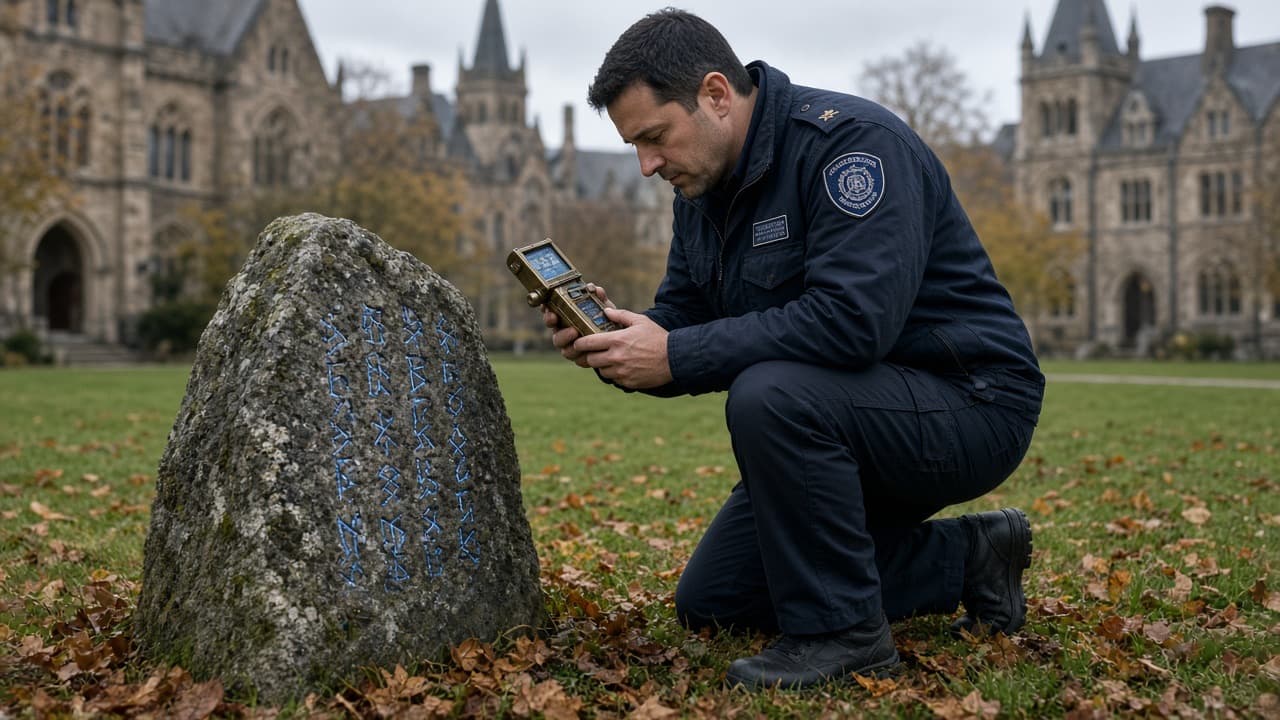
Consistent with long-standing campus practice, the site was surveyed in advance for archaeological and barrow remains by the Department of Arcane History. None were found. A small ward-blessing was performed by Captain Delphine Osei-Barrow, Chief of Campus Safety & Ward Maintenance, to establish protective boundaries for the construction period.
"On behalf of the Board, I want to thank every donor who made today possible," Blackwood said. "This is the most significant investment in healing education in the university's history, and the trustees could not be prouder to support it."
Construction updates
Construction is being managed by Granite State Builders and is expected to proceed through summer 2028. Temporary fencing is now in place along the east campus path, and pedestrians should follow posted detours between Lantern Quad and the Verdance Conservatories. Noise-generating work is limited to weekdays from 7:00 a.m. to 5:00 p.m.
Donors interested in supporting the Quill Center, including naming opportunities for the Simulation Ward and Apothecary Garden, can learn more through Giving to Fablehurst.
- healing arts
- construction
- campus
- facilities
- nursing